Anchoring Mastery: The Art & Science of Holding Ground
Anchoring Mastery: The Art & Science of Holding Ground
Few skills separate a seasoned mariner from a nervous novice quite as decisively as the ability to anchor well. It is deceptively simple on the surface — drop the hook, pay out some chain, go below for sundowners — yet beneath that casual confidence lies a rich body of knowledge spanning metallurgy, fluid dynamics, seabed geology, and now, digital technology. This is your complete guide to ground tackle mastery.
Why Anchoring Is the Most Underestimated Skill in Recreational Boating
Ask any cruising sailor about their worst night afloat and the chances are an anchor features somewhere in the story. A dragging hook in a crowded anchorage at 2 a.m., in rising wind, with a lee shore two cables astern — that is an experience that sharpens the mind and the seamanship in equal measure. Yet despite its critical importance, anchoring rarely receives the same attention as sail trim, navigation, or passage planning in recreational boating education.
The truth is that anchoring is both an art and a science. The art lies in reading an anchorage — assessing wind direction, tidal streams, swinging room, seabed texture, and the behaviour of neighbouring vessels. The science lies in understanding the physics of load, the mechanics of holding power, and the engineering behind the wide variety of anchor designs available today. Master both, and you will sleep soundly on anchor wherever in the world you choose to drop the hook.
Know Your Ground Tackle: The Five Principal Anchor Types
The world of recreational anchoring is dominated by five classic designs, each with its own strengths, weaknesses, and preferred seabed conditions. Understanding the differences is the foundation of any serious anchoring strategy.
CQR (Plough Anchor)
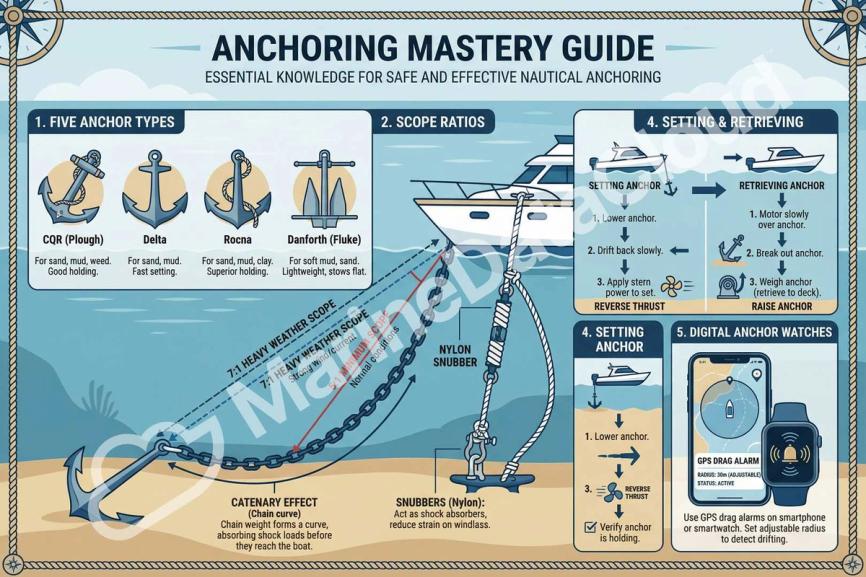
Developed in Cambridge in the 1930s by Sir Geoffrey Taylor, the CQR — whose name is a phonetic play on "secure" — became the dominant cruising anchor for much of the twentieth century. Its hinged plough-shaped fluke is designed to pivot and reset when the direction of pull changes, making it well suited to tidal anchorages where the boat swings with the tide. It performs admirably in sand and stiff mud and can penetrate weed reasonably well, though independent testing has shown its holding power per kilogram of weight to be modest compared to newer generation designs. It remains a reassuring, proven choice for conservative cruisers with traditional sensibilities.
Delta Anchor
The Delta emerged as a fixed-shank evolution of the CQR concept, developed by Simpson-Lawrence in the 1980s. With no hinge to wear or fail, it is mechanically simpler and sets more reliably than its predecessor. The weighted tip drives the fluke down into the seabed consistently, and its ballasted design means it falls point-first from the bow roller every time. The Delta excels in sand and firm mud, performs adequately in light weed, and remains one of the most popular OEM anchors fitted to production yachts. Comparing the Delta anchor vs Rocna, the Delta is generally considered easier to stow on a bow roller but slower to set deeply.
Rocna Anchor
Designed by New Zealander Peter Smith and introduced in the early 2000s, the Rocna represents the vanguard of modern anchor engineering. Its roll bar — a distinctive feature that distinguishes it immediately — ensures the fluke rotates to the correct angle of attack regardless of how it lands on the seabed, before driving deeply into the substrate. Independent tests have consistently shown the Rocna to produce exceptional holding power per kilogram across a wide range of conditions, performing outstandingly in sand, mud, and clay. It is the gold standard for offshore cruisers who demand maximum holding power and fast, reliable setting.
Danforth (Fluke Anchor)
The Danforth, patented by Richard Danforth in 1939, is the archetypal lightweight, high-holding-power anchor. Its twin pivoting flukes drive deeply into soft mud and sand, generating enormous holding power relative to its weight — a quality that made it the preferred choice for naval landing craft and small powerboats alike. However, it struggles profoundly in rocky ground, hard clay, and thick weed, and once broken out can be difficult to reset. It also lies flat, making it easy to stow on a foredeck. For dinghy sailors and powerboaters anchoring in sheltered waters with soft seabeds, it remains a superb choice.
Bruce (Claw Anchor)
Originally engineered for fixing North Sea oil rigs to the seabed in the 1970s, the Bruce anchor was scaled down for recreational use and became enormously popular through the 1980s and 1990s. Its three-dimensional claw shape means it will self-orient on almost any surface, and it sets quickly and reliably in mud and sand. It performs respectably in rocky seabeds where other anchors struggle, and its open claw design resists clogging with weed better than most. Its weakness is modest ultimate holding power compared to modern designs, and it can break out under load direction changes. Nevertheless, its versatility and ease of use maintain its loyal following among recreational boaters.
Seabed Composition: Matching Anchor to Ground
Selecting the right anchor for the right seabed is not merely academic — it is the difference between a peaceful night and a crisis. Before dropping the hook, consult your chart: the seabed character is marked using standardised abbreviations (S for sand, M for mud, R for rock, Wd for weed, Co for coral).
| Seabed | Best Choice | Avoid |
| Sand | Rocna, Delta, Danforth | Bruce (moderate) |
| Soft Mud | Danforth, Rocna, CQR | Delta (may not penetrate) |
| Rock | Bruce, CQR | Danforth (will not set) |
| Weed | CQR, Bruce | Danforth, Rocna (can clog) |
| Hard Clay | Rocna, Delta | Danforth (bounces off) |
No anchor is universally perfect. Experienced offshore cruisers typically carry two anchor types — a primary workhorse for the most common conditions encountered on their cruising ground, and a secondary hook suited to the more challenging seabeds they may encounter.
Scope Ratios: The Geometry of Holding Power
Scope — the ratio of the length of rode deployed to the depth of water (measured from the bow roller to the seabed at high water) — is one of the most important variables in anchoring physics, and one of the most frequently misunderstood.
The fundamental principle is straightforward: the shallower the angle of pull at the anchor, the more efficiently the fluke is driven downward into the seabed. A steep angle of pull will simply extract the anchor; a near-horizontal pull will load it most efficiently. As a general rule of thumb:
- All-chain rode: A minimum scope of 5:1 in moderate conditions, with 7:1 strongly recommended in wind above 20 knots.
- Rope/chain combination: A minimum of 7:1, ideally 10:1 in heavy weather, as the lack of chain weight reduces the catenary effect.
In tight anchorages, deeper water, or where swinging room is limited, many experienced cruisers accept reduced scope with a greater awareness of the risk involved — and compensate with a heavier anchor or a snubber.
The Catenary Effect: Your Invisible Shock Absorber
The catenary refers to the natural curve or droop of the anchor chain hanging in a lazy arc between the bow and the seabed. This curve is not merely aesthetic — it is a critical mechanical property. When a gust loads the rig and the boat surges back, the chain must first be tensioned to straight before any direct shock load is transmitted to the anchor. That progressive tensioning acts as a spring, absorbing the snatch load and preventing the sudden jerks that break anchors out of the seabed.
However, the catenary effect diminishes significantly in deep water, where chain hangs near-vertically regardless of scope, and in very strong winds, when the chain is blown straight by the force of the rode. This is why the catenary alone cannot be relied upon as the sole method of shock absorption — and why the snubber becomes indispensable.
Snubbers: The Unsung Heroes of Safe Anchoring
A snubber is a length of nylon rope — typically 10 to 15 metres, though vessel size and conditions will dictate the ideal length — attached to the chain using a chain hook or splice, then led forward to a cleat or samson post. The chain is then eased until the snubber takes the load, hanging in a slight curve.
Nylon's elasticity — it stretches under load and returns energy progressively — means the snubber acts as a dedicated shock absorber, protecting both the anchor from snatch loads and the windlass from the stresses of a chain under tension. The benefits are multiple: reduced noise from a taut chain drumming on the bow roller, reduced load on the anchor, and significantly improved holding performance in gusty conditions. Any cruiser who has spent a windswept night listening to a chain-caterwauling bow roller will never again venture to anchor without one.
Setting and Retrieving an Anchor in Challenging Conditions
Setting the Anchor
The cardinal rule of setting an anchor is patience and method. Motor slowly upwind or up-tide of your chosen spot. As the vessel loses way, lower — do not throw — the anchor to the seabed. Pay out chain as the vessel drifts back, then, once sufficient scope is deployed, apply steady stern power for 30–60 seconds. Watch a fixed transiting point ashore: if it remains constant, the anchor is holding. If it moves, you are dragging.
In challenging conditions — strong wind, significant tidal stream, or poor holding ground — consider these advanced techniques:
- Backing down hard: Apply 1,500–2,000 rpm in reverse for a full minute to verify the set. If the anchor drags, better to discover it now than at midnight.
- Baiting the anchor: In rocky or mixed ground, lash a weight (a kellet or sentinel) to the chain at 15–20 metres, which depresses the rode and improves the angle of pull.
- Tandem anchoring: Deploy two anchors in series on the same rode for extreme conditions, with the secondary anchor acting as a pre-tension device.
Retrieving the Anchor
Motor slowly towards the anchor whilst recovering chain, keeping the rode vertical rather than dragging it along the seabed. When the chain is near-vertical, the anchor will break out with a sharp burst of engine power. In rocky ground, a trip line — a light line attached to the crown of the anchor and buoyed at the surface — allows the anchor to be extracted from the reverse direction, breaking it free when the shank angle would normally lead to a permanent snag.
Anchor Watches and the Digital Revolution
Even the most meticulously set anchor can drag if conditions deteriorate beyond predicted parameters. The traditional anchor watch — a rotating crew member who monitors the vessel's position through the night — is as old as seamanship itself. Today, digital technology has transformed this exhausting but essential practice.
Modern GPS anchor alarm systems establish a digital radius around the vessel's position at the moment of anchoring. If the vessel drifts beyond that radius, an alert is triggered — on the chartplotter, on a dedicated app, or via a push notification to a smartphone. Dedicated apps such as Anchor Alert, AnchorGuardian, and Savvy Anchor Alarm allow skippers to set precise drag radii, monitor position in real time, and receive instant alerts even whilst sleeping below. Some systems, such as the TIMEZERO anchor alarm, integrate directly with the vessel's chartplotter for continuous positional monitoring.
For serious cruisers, the integration of anchor watch functionality into multifunction chartplotter systems and sailing apps has been transformative. Key features to look for include:
- Adjustable drag radius to account for swinging room
- GPS accuracy indication — a system is only as reliable as its position fix
- Offline functionality — internet connectivity cannot be assumed in a remote anchorage
- Push notifications to crew smartphones for shared watch-keeping
The technology does not replace seamanship — it augments it. A well-set anchor in a correctly chosen spot with adequate scope and a fitted snubber, monitored by a calibrated digital anchor watch, represents the full synthesis of traditional skill and modern capability.
Summary: The Key Takeaways for Anchoring Mastery
Anchoring well is one of the most rewarding competencies a mariner can develop. Here are the essential principles to carry with you on every passage:
- Match anchor to seabed: The Rocna and Delta excel in sand; the Danforth dominates soft mud; the Bruce and CQR are the most versatile across mixed and rocky ground.
- Scope is non-negotiable: Deploy at minimum 5:1 for all-chain in calm conditions, and increase to 7:1 or beyond as conditions worsen.
- Respect the catenary — but don't rely on it alone: In deep water and strong winds, the catenary diminishes. Always rig a snubber.
- Set the anchor properly: Apply stern power after deploying to confirm the anchor is dug in. A 60-second backing-down test is the price of a quiet night.
- Use a trip line in rocky ground: It is 10 minutes of preparation that can save hours of frustration — or an anchor.
- Embrace digital anchor watches: GPS drag alarms do not replace the watch on deck, but they transform the quality and safety of overnight anchoring.
- Carry a second anchor: Conditions change. A storm anchor stowed below is an insurance policy no prudent mariner should sail without.
The sea rewards preparation and punishes complacency. Your ground tackle is the last line of defence between a tranquil night at anchor and a very bad story for the sailing club bar. Choose it wisely, deploy it methodically, and monitor it diligently — and the anchorages of the world will open up to you with all their peace and beauty.