Penny-Wise, Pound-Foolish: The Hidden Costs of Skipping Boat Maintenance
Why Preventive Maintenance Is the Smartest Investment You Can Make Aboard
Every seasoned skipper knows the sea rewards preparation and punishes complacency. Yet year after year, boat owners fall into the same costly trap — deferring routine service to save a few pounds, only to haemorrhage hundreds or even thousands when something fails catastrophically at the worst possible moment. The truth is blunt: reactive maintenance will always cost you more than preventive upkeep. Always. No exceptions.
The maritime industry has a word for vessels that are perpetually patched up rather than properly maintained — "money pits". And the irony is that the owners of those boats usually started out trying to save money. This is the very essence of being penny-wise and pound-foolish: spending less now to spend far, far more later.
The Impeller: A £30 Part That Can Destroy a £10,000 Engine
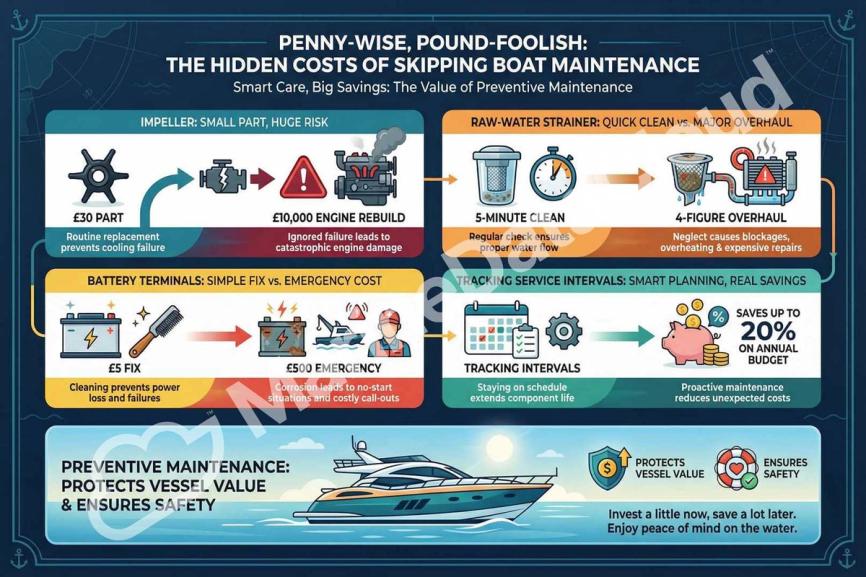
Few components illustrate the cost of neglect more dramatically than the raw-water pump impeller. This humble rubber component — typically costing between £25 and £60 to replace — is the beating heart of your engine's cooling system. It draws seawater through the hull and pushes it around the engine to prevent overheating.
Most manufacturers recommend replacing the impeller every one to two years or every 100–200 engine hours. It is a straightforward, low-cost service task. Yet many owners skip it, banking on the idea that "it still seems fine."
When an impeller fails — and it will fail — the rubber vanes crack, fragment, and lose their ability to circulate cooling water. Engine temperature climbs rapidly. If the skipper does not catch it in time, the consequences cascade: a warped cylinder head, blown head gaskets, a seized engine block. The bill for an engine rebuild or replacement can run anywhere from £5,000 to over £15,000. That is the real price of deferring a £30 part and an hour of labour.
The Raw-Water Strainer: Small Screen, Enormous Consequences
Positioned between the seacock and the raw-water pump, the raw-water strainer is your engine's first line of defence against debris — weed, barnacle fragments, plastic, jellyfish — anything the sea decides to send your way. Cleaning it takes five minutes and costs nothing beyond a moment of your time.
When neglected, the strainer becomes progressively blocked. Restricted water flow starves the impeller of cooling water, accelerating its wear and eventual failure. Debris that bypasses a corroded or cracked strainer basket can lodge in the pump impeller, clog heat exchanger tubes, or cause dangerously uneven engine cooling.
The compounding effect is insidious. One blocked strainer does not just cost you a new strainer basket — it can trigger an impeller replacement, a heat exchanger flush, and potentially a full cooling-system overhaul. A component that costs less than £20 to service can, if ignored, generate repair bills that stretch into four figures.
Corroded Battery Terminals: When a £5 Fix Becomes a £500 Emergency
Marine battery corrosion is one of the most under-appreciated risks in boating. The salt-laden marine environment is relentlessly aggressive on electrical connections, and battery terminals are particularly vulnerable. That familiar blue-white crystalline crust building up on your terminals is not merely unsightly — it is electrically catastrophic.
Corrosion increases resistance at the terminal, degrading the battery's ability to deliver full current to your starter motor, electronics, and safety systems. Left unchecked, the corrosion migrates into the battery cable itself, compromising the entire conductor. At that point, the fix is no longer a wire brush and a spray of terminal protector — it is rewiring, new cables, potentially a new battery, and marine electrician's labour fees that can rapidly exceed £500.
The preventive solution? A periodic inspection, a clean with a bicarbonate of soda solution, and a coat of terminal protection spray. The entire task costs pennies and takes ten minutes. That is the economics of preventive maintenance in its purest form.
Tracking Service Intervals: Your Budget's Best Friend
The single most powerful thing a boat owner can do to control maintenance costs is to track service intervals systematically. A well-maintained service log transforms reactive chaos into organised, predictable upkeep. You know when the impeller was last changed, when the anodes are due, when the engine oil needs refreshing, and when the raw-water strainer last had a thorough inspection.
Studies in marine fleet management have found that unexpected repairs can cost operators up to 20% of their annual maintenance budget beyond what scheduled service would have cost. For a private boat owner, that figure is no less alarming — it translates directly into ruined weekends, emergency haulouts, and marina mechanic call-out fees charged at premium rates.
A structured maintenance schedule — whether logged in a physical book, a spreadsheet, or a dedicated digital tool — allows you to anticipate expenditure rather than react to it. You can budget for an impeller and a set of anodes in January rather than fund an emergency engine repair in August. You shift from being a passenger in your own maintenance story to being the captain of it.
The Bigger Picture: Vessel Value and Safety at Stake
The financial argument for preventive maintenance is compelling enough on its own, but it does not tell the whole story. A well-documented service history meaningfully increases a vessel's resale value. Prospective buyers — and marine surveyors — scrutinise maintenance records carefully. Gaps in service history raise red flags that translate directly into lower offers or failed surveys.
Beyond the financial, there is the matter of safety. A cooling system failure mid-passage is not just expensive — it can be genuinely dangerous. Electrical faults from corroded terminals are a leading cause of onboard fires. A blocked raw-water strainer that triggers an overheated engine can leave you drifting without propulsion in busy shipping lanes or deteriorating weather.
Preventive maintenance is not a cost — it is an investment in the vessel, the voyage, and the lives aboard.
Summary: Key Takeaways for Every Boat Owner
- Impeller replacement (£30–£60 and one hour of labour) prevents engine failures that can cost £5,000–£15,000+ to rectify.
- Raw-water strainer cleaning takes five minutes and costs nothing; ignoring it can cascade into a full cooling-system overhaul.
- Battery terminal maintenance costs pennies; corrosion left unchecked can result in rewiring bills exceeding £500.
- Tracking service intervals removes guesswork, enables accurate budgeting, and prevents the expensive surprise of reactive repair.
- Documented maintenance history protects and enhances vessel resale value, and is scrutinised during marine surveys.
- The overarching principle: scheduled preventive maintenance consistently costs a fraction of corrective reactive repair — no matter the component, no matter the vessel.