Sailing with Peace of Mind: The Mental Side of Cruising
The clearest horizon starts in your head!
When the Joy of Sailing Gets Lost in the Noise
There is a particular kind of silence that every sailor dreams of — the quiet hum of wind in the rigging, the rhythmic slap of a hull cutting through clean water, the world reduced to compass bearing and open sea. It is precisely why most of us fell in love with sailing in the first place.
And yet, for a great many boat owners, that silence is anything but peaceful. Beneath the surface — much like the unseen hull below the waterline — there is a constant, low-grade hum of mental noise. Unresolved maintenance jobs. An insurance renewal you meant to action last Tuesday. A survey recommendation you filed away and quietly forgot. A service interval creeping up somewhere in the engine bay.
This is the hidden psychological cost of boat ownership, and it is more corrosive than most sailors will ever admit.
The Weight of What's Left Undone
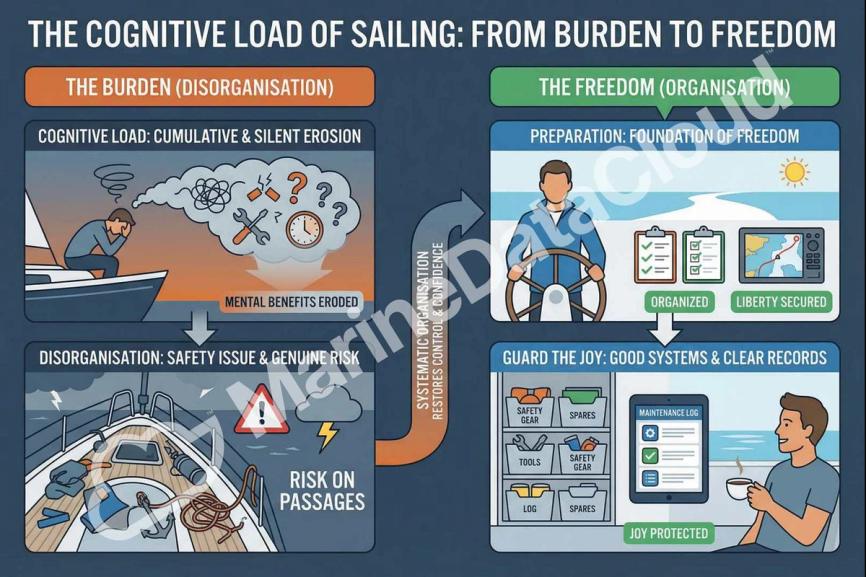
Psychologists call it cognitive load — the mental bandwidth consumed by tasks that remain open, unresolved, or incomplete. For boat owners, this load is uniquely relentless. Unlike a car or a home, a vessel demands multi-layered attention across an extraordinary range of systems: mechanical, structural, electrical, regulatory, and safety-critical. Each open loop — an unchecked bilge pump, a fraying sheet, a lapsed flare — occupies a corner of your mind, even when you are nowhere near the marina.
Research consistently confirms what experienced cruisers already know intuitively: water environments have a profound capacity to restore mental clarity and reduce anxiety. But that restorative power is brutally undermined when you arrive at the dock already carrying a mental manifest of unresolved problems. The boat that was supposed to be your escape becomes, instead, another source of pressure.
The irony is sharp. You bought the boat to get away from it all. But without a structured system to manage her, the boat follows you home — not in the marina, but in your mind.
Mental Clutter: The Silent Thief of the Sailing Life
Consider a typical weekend passage. You cast off on a Friday evening with a promising forecast, but somewhere between the first tack and the second glass of rum, the nagging begins. Did I log the last antifoul date? When is the liferaft service due? I need to check that stern gland before the next passage. These are not catastrophic concerns in isolation, but collectively they form a kind of mental fog — a cognitive weather system that quietly steals your presence from the cockpit and from the people sailing with you.
This phenomenon is well-documented in broader wellness research. Studies from maritime environments suggest that the mental benefits of time at sea are most fully realised when sailors feel prepared and in control of their vessel's condition. The moment that sense of mastery erodes — when maintenance lapses accumulate and records go untracked — anxiety quietly fills the gap.
For blue-water cruisers, the stakes are higher still. A passage crew relying on disorganised or incomplete boat records is not merely stressed — they are potentially unsafe. The mental burden of holding a vessel's entire service history in one's head, across months and nautical miles, is neither sustainable nor wise seamanship.
Organisation as the Antidote
The great navigators of history understood something that modern sailors sometimes forget: preparation is the foundation of freedom. Sir Francis Chichester, who completed his solo circumnavigation aboard Gipsy Moth IV in 1966–67, was famously meticulous in his preparation and record-keeping. His extraordinary voyage was not a triumph of spontaneity — it was the product of obsessive, systematic organisation that allowed him to sail with genuine confidence.
That same principle applies to every sailor, whether you're coastal hopping along the Solent or crossing the Atlantic. The antidote to mental clutter is not less sailing — it is better systems. When every maintenance task has a home, every deadline is visible, and every service record is logged and retrievable, the cognitive load lifts. The mental fog clears. And suddenly, the cockpit is peaceful again.
A structured approach to boat management — one that captures tasks, tracks service intervals, stores documentation, and surfaces upcoming deadlines — does something far more valuable than keep your vessel in good order. It gives you your mind back. It transforms the act of boarding your boat from one of subconscious anxiety into one of genuine anticipation.
Reclaiming the Joy
The sailors who report the greatest satisfaction with boat ownership are rarely those with the newest or most expensive vessels. They are, overwhelmingly, those who feel on top of their boat — who know her systems, trust her maintenance record, and can walk aboard without a mental checklist already firing at the back of their minds.
That state of mind is not reserved for professional captains or career deliverers. It is entirely achievable for the weekend sailor and the liveaboard alike — but it requires intentionality. It requires treating your boat's information — her documents, her service history, her equipment specs, her pending tasks — with the same care you give her hull and her rig.
Because the truth is this: a well-sailed boat begins not at the helm, but at the desk. The clearest passage starts with a clear head. And a clear head starts with knowing — truly knowing — that your vessel is accounted for, recorded, and ready.
Summary: Key Takeaways for the Organised Sailor
- Cognitive load is real and cumulative. Unresolved boat tasks accumulate silently in your mind, eroding the mental benefits that sailing is uniquely positioned to provide.
- Disorganisation is a safety issue, not just a comfort one. Missing service records, lapsed certificates, and forgotten maintenance create genuine risk, particularly on extended passages.
- Systematic organisation restores control and confidence. When your boat's data is structured, visible, and up to date, the psychological burden of ownership lifts dramatically.
- Preparation is the foundation of freedom. History's greatest voyagers were not reckless adventurers — they were meticulous record-keepers who earned their peace of mind through disciplined preparation.
- The joy of sailing is available to everyone — but it must be protected. Guard it with good systems, clear records, and the quiet confidence that comes from knowing your vessel, inside and out.