Your Onboard Inventory: The Unsung Hero of Seamanship
If You Don't Know What's Aboard, You Don't Know Your Boat!
What Is Onboard Inventory Management — and Why Does It Matter?
There is a quiet discipline that separates the truly prepared mariner from the casual weekend sailor, and it has nothing to do with knot-tying or weather routing. It is the humble, unglamorous, yet absolutely indispensable practice of onboard inventory management. Knowing precisely what is aboard your vessel — where it is stowed, when it expires, and what part number to order when it fails — is the backbone of genuine seamanship.
Think of your boat as a self-contained world. Once you leave the dock, you cannot pop to a chandlery for a missing impeller or a fresh flare kit. Every item you carry, or fail to carry, is a decision you made before casting off. The organised skipper who maintains a living, breathing inventory list is the one who gets home safely and keeps their crew confident in every sea state.
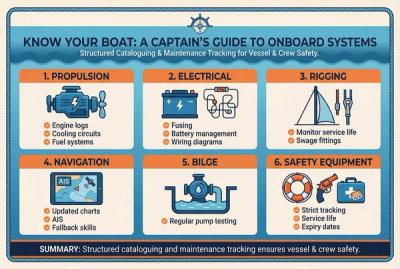
Onboard inventory encompasses far more than a rough mental note of what you think is in the bilge locker. It means cataloguing every spare part, every consumable, every piece of safety equipment — with full detail: part numbers, manufacturer references, quantities on hand, storage locations, and critically, expiry dates. This is not bureaucracy for its own sake. This is seamanship at its sharpest.
Spares and Consumables: The Engine Room of Preparedness
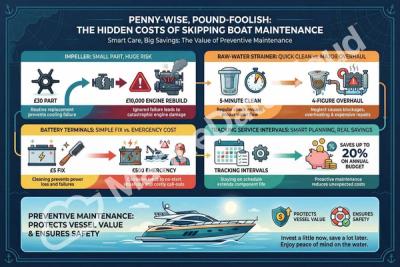
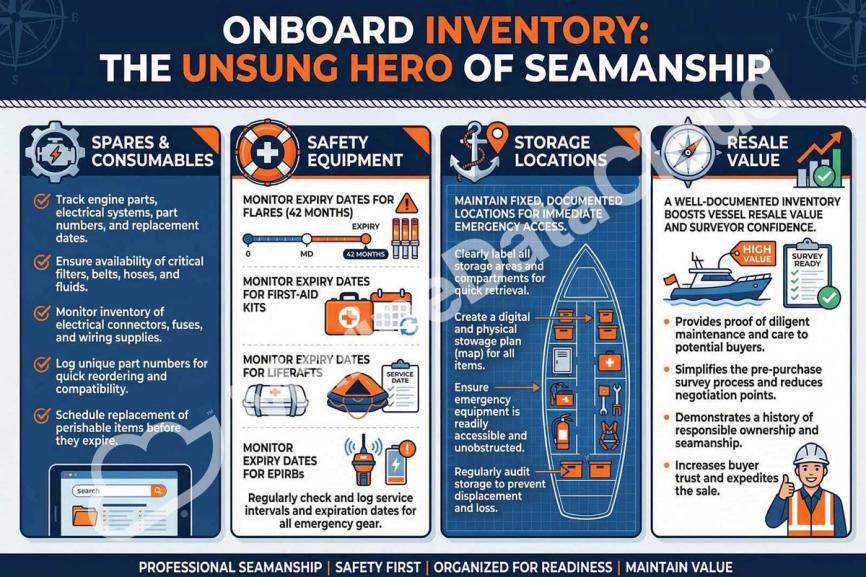
A well-stocked spares inventory begins with an honest audit of your vessel's critical systems. Engine spares are the obvious starting point: impellers, belts, fuel filters, oil filters, zincs, and injectors should all be listed by part number, cross-referenced against your engine's service manual, and logged with the date of last replacement. Consumables such as engine oil, hydraulic fluid, coolant, and bilge pump lubricant should be tracked by quantity and topped up on a rolling schedule.
Beyond the engine room, consider your electrical systems — fuses, spare bulbs for navigation lights, spare batteries for handheld VHF radios, and cable connectors. Rigging spares matter enormously on sailing vessels: a spare cotter pin or clevis pin may seem insignificant at anchor but becomes mission-critical at sea. Every item should be recorded with its storage location — port cockpit locker, forward berth starboard bin, engine bay shelf — so that any crew member can locate it without hesitation in an emergency.
The discipline here is not just about having the right part; it is about knowing you have it. An impeller that has rolled to the back of an unknown locker provides no more real security than no impeller at all.
Safety Equipment: Where Expiry Dates Save Lives
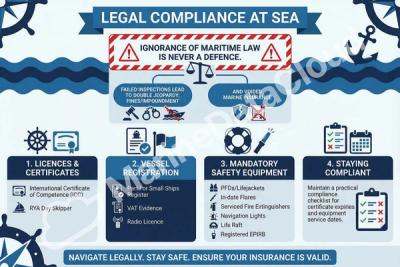
Few areas of onboard inventory carry higher stakes than safety equipment, and few areas are more commonly neglected when it comes to date management. Pyrotechnic flares are among the most time-sensitive items aboard. Under international maritime guidelines and SOLAS requirements, marine pyrotechnics — including aerial flares, hand-held signals, and smoke signals — expire 42 months from their date of manufacture. Carrying expired flares is not only ineffective in a genuine distress situation; it may also constitute a legal infringement depending on your flag state's regulations.
Your first-aid kit demands the same vigilance. Medications, antiseptic creams, adhesive dressings, and eyewash solutions all carry expiry dates that must be logged and honoured. An out-of-date antihistamine or an exhausted epinephrine auto-injector could represent the difference between a manageable medical incident and a catastrophe. Record the expiry date of every item in your kit, and set a calendar reminder to review and replenish annually — or after any use.
Liferaft servicing, EPIRB battery replacement dates, lifejacket hydrostatic release cartridge expiry, and fire extinguisher inspection stamps are all time-bound obligations that belong in a formalised inventory rather than a vague mental checklist. The organised mariner assigns a unique identifier or part number to each piece of safety-critical equipment and tracks its service history alongside its replacement schedule.
Storage Locations: The Chart of Your Ship's Contents
A great inventory is only half the solution. The other half is knowing exactly where everything lives. Assign every item a permanent, logical storage location and record it in your inventory system. Group items sensibly: all safety equipment in a designated, easily accessible location; engine spares together in a dry, labelled container; medical supplies in a clearly marked, waterproof kit stored at a consistent location known to every person aboard.
Consistency is the keystone here. When your inventory records that the spare VHF battery is in the nav station starboard drawer, it must always be in the nav station starboard drawer. The value of a storage location entry collapses immediately if items are stowed wherever they happen to fit on the day. Train your crew. Brief your guests. Make the location of every critical item part of your pre-departure safety briefing.
Inventory Management and Resale Value: The Hidden Commercial Dividend
Beyond the immediate safety argument, a meticulous onboard inventory delivers a compelling commercial benefit: it substantially enhances your vessel's resale value. Prospective buyers and their surveyors are sophisticated; they recognise the difference between a vessel whose owner has documented every spare part, every service record, and every safety equipment replacement, and one whose history is a mystery.
A well-maintained, fully documented inventory log signals that the vessel has been professionally managed. It reduces uncertainty for the buyer, shortens the survey process, and can command a meaningfully higher asking price. In a competitive brokerage market, the paper trail you create today is the premium you collect tomorrow.
Summary: Your Inventory Is Your Seamanship Manifesto
- Onboard inventory management is a core seamanship discipline, not an administrative afterthought.
- Catalogue all spares and consumables with part numbers, quantities, replacement dates, and storage locations.
- Safety equipment — flares, first-aid kits, liferafts, EPIRBs, fire extinguishers — must be tracked with precise expiry and service dates; pyrotechnic flares expire 42 months from manufacture.
- Assign every item a fixed, documented storage location and brief all crew accordingly.
- A thorough inventory log is a direct investment in your vessel's resale value and surveyor confidence.
- The skipper who knows every item aboard, down to the last cotter pin, is the skipper who is truly ready for sea.