Legal Compliance at Sea: What Every Skipper Must Know

The Coastguard Doesn't Accept 'I Forgot' as an Answer!
Why Legal Compliance Isn't Optional — It's Your First Line of Defence
Whether you're casting off from a marina in the Mediterranean, navigating the waters off New Zealand, or cruising the British coastline, one truth holds firm across every jurisdiction: ignorance of maritime law is never an acceptable defence. For recreational mariners, legal compliance isn't bureaucratic box-ticking — it's the foundation upon which safe, responsible seamanship is built. Get it wrong, and you face a double jeopardy that can sink far more than your vessel: failed inspections can result in fines, impoundment, or prosecution, whilst non-compliance simultaneously voids your marine insurance policy — leaving you personally liable for damages, salvage costs, and third-party claims that could run into hundreds of thousands of pounds.
This guide is designed for every skipper — new boat owner or seasoned bluewater sailor — who wants to navigate the regulatory seascape with confidence.
Licences and Certificates of Competence: Know What You Need
The first instrument on your compliance chart is operator competence certification. Requirements vary by country, but the internationally recognised benchmark for recreational boaters is the International Certificate of Competence (ICC), issued under the United Nations Economic Commission for Europe (UNECE) framework. Recognised across European inland and coastal waters, the ICC certifies that a skipper meets a defined standard of practical and theoretical knowledge.
In the United Kingdom, the RYA Day Skipper qualification is widely recognised as the gateway coastal certification, whilst the RYA Yachtmaster Offshore and Ocean certificates are the gold standard for offshore and bluewater passages. The ICC itself is valid for five years and is available free to qualifying RYA members. Elsewhere, national equivalents — such as the French Permis Bateau, the Spanish PER, or the US Coast Guard-issued Master's Licence — govern what vessels you are legally permitted to operate.
Skipper's Tip: Always carry original or certified copies of your certificates on board. A digital scan on your phone may not satisfy a boarding officer.
Vessel Registration and Documentation: Your Boat's Legal Identity
Just as a vessel needs a competent skipper, it needs its own legal identity. Vessel registration is mandatory in most jurisdictions for recreational craft above a certain length or engine capacity. In the UK, boats can be registered on Part I of the British Register of Ships (full registration, recognised internationally) or under the Small Ships Register (SSR). Part I registration is strongly recommended for vessels venturing abroad, as it provides unambiguous proof of nationality and ownership — critical when entering foreign ports or dealing with customs authorities.
Documentation to keep permanently on board typically includes:
- Certificate of Registry or SSR documentation
- VAT evidence (for EU waters, proof of VAT-paid status is essential)
- CE marking documentation or RCD (Recreational Craft Directive) compliance certificate for vessels built after 1998
- Radio Licence (for any vessel carrying VHF radio equipment)
- Ship's Radio Operator Licence (the Short Range Certificate, or SRC, is the minimum requirement for operating VHF DSC radio)
Mandatory Safety Equipment: The Non-Negotiables
Here is where inspections focus — and where non-compliance most commonly triggers both legal penalties and insurance voidance. Regardless of your flag state, the core safety inventory for a recreational vessel includes:
- Personal Flotation Devices (PFDs) / Lifejackets — correctly sized, serviced, and accessible for every person on board
- Flares and pyrotechnic signals — within their expiry date (typically four years)
- Fire extinguishers — serviced annually, appropriate to vessel size and engine type
- Sound-signalling devices — horn or whistle, as required by the International Regulations for Preventing Collisions at Sea (COLREGs)
- Navigation lights — fully functional and compliant with COLREGs Annex I specifications
- Life raft or life buoy — for offshore passages, a certified, serviced life raft is essential
- EPIRB (Emergency Position Indicating Radio Beacon) — registered with the relevant national authority (in the UK, the MCA)
- First aid kit — stocked and within expiry dates
- Bilge pump — manually operable, in working condition
- Anchor and adequate ground tackle
Critical Warning: Expired flares or an unserviced fire extinguisher are among the most common reasons a claim is rejected by marine insurers. An insurer will argue that the vessel was not maintained in a seaworthy condition — and they will win.
The Double Jeopardy: Failed Inspections AND Voided Insurance
This is the aspect of maritime compliance that new boat owners consistently underestimate. A Coastguard or harbour authority inspection that reveals deficiencies does not merely result in a fine or a verbal warning. Depending on severity, it can lead to:
- Prohibition notice — the vessel cannot leave the berth until defects are rectified
- Fixed penalty notices or prosecution under national maritime legislation
- Impoundment of the vessel
- Criminal liability in cases involving serious safety breaches
However, the parallel consequence — insurance voidance — is arguably the more devastating financial outcome. Marine insurance policies universally contain a seaworthiness warranty clause. If your vessel is found to be non-compliant with mandatory equipment requirements or registration obligations at the time of an incident, your insurer is legally entitled to decline the claim in full. This means that a collision, fire, or sinking — events that could generate claims of £50,000 to several million — fall entirely upon your personal finances.
Some policies also include a "due diligence" clause, requiring the owner to maintain the vessel in proper repair. Failure to complete annual safety equipment servicing, or operating with an unqualified skipper, can trigger this clause even in the absence of a formal inspection.
Staying Compliant: A Practical Checklist Approach
The most effective skippers treat compliance like passage planning — systematic, documented, and reviewed regularly. A robust compliance log should record:
- Certificate expiry dates (ICC, SRC, STCW if applicable)
- Flare batch numbers and expiry dates
- Fire extinguisher service dates
- Life raft service certificate details
- EPIRB registration and battery expiry
- VHF Radio Licence renewal date
- Vessel registration renewal
- Annual insurance policy review, including coverage scope and exclusions
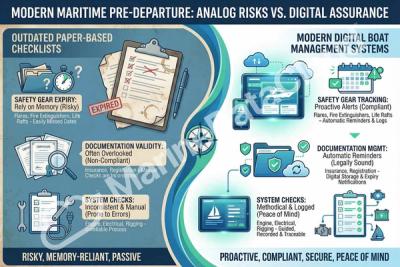
Digitalising this data ensures nothing slips through the net between seasons. Cloud-based vessel management tools now allow skippers to set automated reminders for critical renewal dates — a significant upgrade from the traditional paper logbook.
Summary: Key Takeaways for Every Skipper
Staying legally compliant at sea is not a seasonal task — it is a continuous, year-round responsibility. Here are the non-negotiable points every mariner must anchor to:
- ⚓ Carry your certificates: ICC, SRC, and national licences must be on board and in date.
- ⚓ Register your vessel properly: Use full Part I registration for international cruising.
- ⚓ Maintain your safety kit: Expired flares, unserviced fire extinguishers, and faulty navigation lights are the most common compliance failures — and insurance claim killers.
- ⚓ Understand COLREGs: They are the Rules of the Road at sea. Ignorance is no defence.
- ⚓ Know your insurance policy: Read the seaworthiness warranty and due diligence clauses in full.
- ⚓ Document everything: A digital compliance log with reminder alerts is your best crew member for regulatory matters.
- ⚓ Respect the double jeopardy: A failed inspection can void your insurance simultaneously — the financial consequences can be catastrophic.
The Coastguard will not accept "I forgot" as an answer. Neither will your insurer. The skippers who thrive — season after season, port after port — are those who treat legal compliance not as a burden, but as an integral part of the seamanship that keeps their crew safe and their adventures uninterrupted.