The Pre-Departure Checklist Reimagined: Are You Really Ready to Cast Off?
From Paper to Port-Ready: Why the Old Way No Longer Cuts It
Every seasoned mariner knows the ritual. You stand on the pontoon, squint at a dog-eared sheet of paper — perhaps tucked inside a yellowing logbook — and tick off a few boxes before slipping the lines. It feels disciplined. It feels professional. But in an age where a modern cruising yacht carries more electronic systems than a mid-1990s aircraft, is a handwritten checklist really keeping you safe? The honest answer, for most of us, is a resounding no.
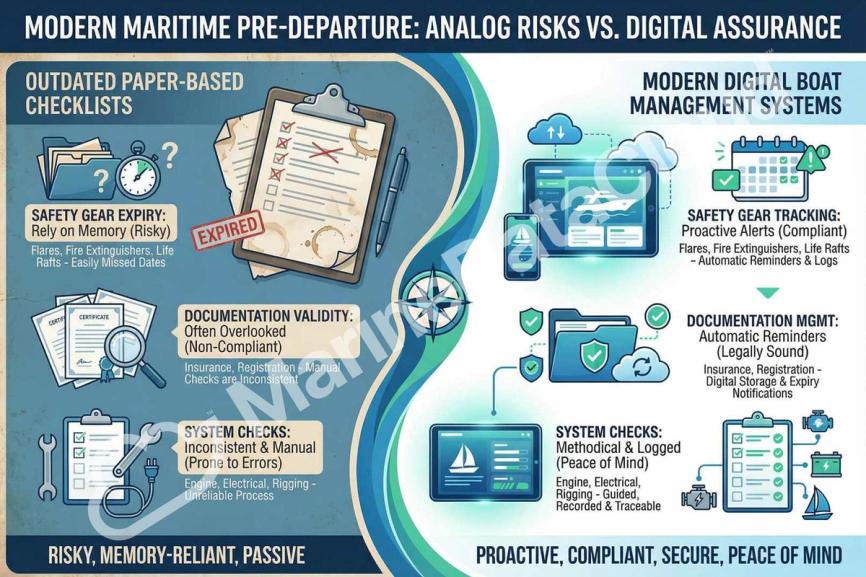
Paper checklists and even basic spreadsheets — yes, that includes your beloved Excel file — were never engineered for the dynamic, multi-layered complexity of a modern vessel. They do not alert you when your fire extinguisher passed its 12-year service deadline. They cannot flag that your flares expired last November. They will not remind you that your boat's insurance certificate needs renewal before you leave harbour. They simply record what you chose to write down, on the day you chose to write it. The gaps between those moments are where danger lives.
What a Modern Pre-Departure Routine Actually Looks Like
A truly robust pre-departure check is not a single act — it is a living, continuously updated system. Think of it less like reading a map and more like navigating with a real-time chart plotter: always current, always contextual, and always connected.
1. Safety Gear Status — Know What You Have and When It Expires
The cornerstone of any pre-departure routine is confirming that your safety equipment is not just present, but operational and in-date. This includes:
- Life jackets and personal flotation devices (PFDs): Checked for inflation integrity, correct sizing, and harness condition.
- Fire extinguishers: Legally required to be replaced after 12 years from the date of manufacture. The date stamp must be verified, not assumed.
- Pyrotechnic signals and flares: These carry strict expiry dates. Carrying out-of-date flares may invalidate your insurance and render you non-compliant with maritime law.
- Life raft: Must be serviced within the manufacturer's recommended interval — typically every one to three years — and inspected by a certified service station.
- EPIRB and PLBs: Batteries and hydrostatic releases carry expiry dates that must be logged and monitored.
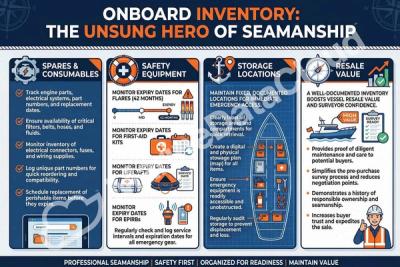
A digital boat management system allows every single one of these items to be catalogued with its service date, expiry date, and a proactive reminder alert. No more surprise discoveries at the dock.
2. Documentation Validity — Your Paperwork Is as Important as Your Sails
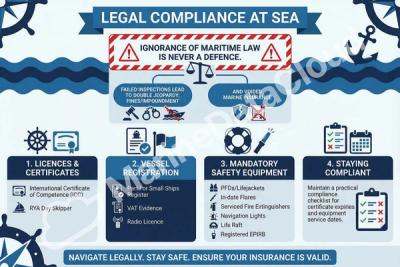
Coast guard inspections are not merely inconvenient — a failed inspection, or worse, a declined insurance claim following an incident, can be financially and legally devastating. Your pre-departure documentation check should cover:
- Vessel registration and certificate of registry: Current and carried aboard.
- Insurance certificate: Valid for the current cruising area, including any offshore or foreign-waters endorsements.
- Radio operator's licence and ship station licence: Mandatory for vessels equipped with VHF DSC radios.
- RYA or flag-state sailing qualifications: Particularly critical when cruising in regulated foreign jurisdictions.
- Recent inspection certificates: Including out-of-water surveys, stability letters, and safety equipment service records.
When these documents are stored and managed digitally — with expiry reminders triggered well in advance — the risk of oversight drops dramatically.
3. Systems Checks — The Engineering Reality of a Modern Vessel
A modern sailing yacht or motorboat is, in truth, a sophisticated piece of marine engineering. Its sub-systems — from the bilge pump and engine cooling circuit to the chart plotter and AIS transponder — require methodical verification before every offshore passage.
Key systems to verify pre-departure include:
- Engine and propulsion: Oil level, coolant, impeller service history, belts, and raw-water strainer.
- Electrical systems: Battery bank state of charge, bilge pump auto-function, navigation lights, and VHF radio operation.
- Navigation equipment: GPS/chart plotter with updated charts, compass deviation card, depth sounder, and AIS functionality.
- Fuel: Sufficient reserve for passage plus contingency — the golden rule being never to depart with less than double the expected fuel requirement.
- Rigging and sails (for sailing vessels): Standing rigging tension, swage fittings, furling systems, and sheet/halyard condition.
- Steering: Full helm lock-to-lock check, autopilot test, and emergency tiller accessibility.
Without a systematic, digitally managed maintenance log, these checks rely entirely on human memory — a notoriously unreliable first mate. Preventive maintenance, logged and scheduled within a dedicated platform, ensures that corrective failures — always the most expensive kind — are the exception, not the norm.
Why Analogue Methods Leave Dangerous Gaps
The critical flaw of paper-based pre-departure systems is not their intent — it is their architecture. Paper cannot push a notification. A spreadsheet cannot cross-reference your flare expiry against today's date and warn you at 06:00 on departure morning. A logbook cannot flag that your life raft was last serviced 38 months ago when the manufacturer mandates a 36-month cycle.
Beyond the immediate safety risks, the analogue approach also creates legal and financial exposure. Coastguard inspections can result in vessel detention or on-the-spot fines for non-compliant safety equipment. Insurance underwriters increasingly expect demonstrable maintenance records — and a tatty spreadsheet is unlikely to satisfy a claims assessor following a serious incident.
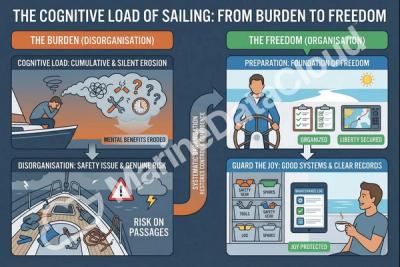
Moreover, the mental load of managing all of this in one's own head is substantial. Experienced mariners speak of the paradox of the cruising mind: you want to be present, relaxed, and alive to the joy of being at sea — but a poorly organised departure gnaws at your concentration long after you've left the marina. Peace of mind is not a luxury on the water. It is a safety imperative.
Charting the Course Forward
The good news is that the technology to transform your pre-departure routine already exists and is increasingly accessible to recreational sailors and bluewater cruisers alike. Modern boat management platforms allow you to centralise your vessel's entire data ecosystem — maintenance schedules, document expiries, inventory, system records, and crew briefing notes — in one place, with timely alerts delivered straight to your device.
Think of it as upgrading from a hand-bearing compass to a fully integrated nav station: the destination is the same, but your situational awareness, accuracy, and confidence are transformed entirely.
The paper checklist had its day. It served generations of mariners faithfully. But as our vessels have grown more complex and our legal obligations more demanding, the analogue routine is no longer fit for purpose. The modern pre-departure checklist is not a piece of paper. It is a living system — and it might just save your life.
Summary
- Paper and spreadsheet-based checklists are fundamentally unsuited to the complexity of modern marine vessels and their regulatory requirements.
- Safety equipment — including fire extinguishers, flares, life rafts, and EPIRBs — carries strict expiry and service intervals that must be actively tracked.
- Documentation validity is a legal requirement; expired certificates can result in coast guard penalties and declined insurance claims.
- Systems checks must cover propulsion, electrical, navigation, fuel, rigging, and steering before every passage.
- Digital boat management replaces reactive, memory-based routines with proactive, reminder-driven systems — reducing risk, cost, and stress simultaneously.
- Peace of mind on passage is directly linked to the thoroughness and reliability of the pre-departure process — and that thoroughness requires the right tools.