Man Overboard, Fire & Flooding: Mastering Your Onboard Emergency Protocols
Man Overboard, Fire & Flooding: Mastering Your Onboard Emergency Protocols
Every voyage begins with optimism — fair winds, blue skies, and the promise of adventure. But the sea is an unforgiving environment, and the difference between a close call and a catastrophe is almost always preparation. This is not a post about fear; it is a post about seamanship.
Introduction: When Seconds Define Survival
There is an old adage amongst experienced mariners: hope for the best, plan for the worst. In recreational boating, that planning is not optional — it is the very foundation of safe passage-making. Three emergencies account for the vast majority of serious onboard incidents: Man Overboard (MOB), fire, and flooding. Each is distinct in its mechanics, yet they share a common denominator — your crew's ability to respond swiftly, correctly, and without panic depends entirely on preparation undertaken long before the lines are cast off.
This article walks you through the essential emergency protocols every skipper must know, the structure of a proper Vessel Safety Check, and how to brief a crew of mixed experience levels before departure. And crucially, we shall return to a theme we explored in a previous post: emergency response is only ever as good as the documentation and drills that underpin it.
Part One: Man Overboard (MOB)
Understanding the Threat
Man Overboard is statistically one of the most common causes of fatality in recreational sailing and powerboating. Cold water shock, exhaustion, and disorientation can incapacitate even a strong swimmer within minutes. A person in water at 10°C may lose meaningful swimming ability in under 30 minutes. Time, in an MOB scenario, is the enemy.
The Traditional MOB Response: Quick Stop
The Quick Stop manoeuvre remains a cornerstone of MOB response for sailing vessels:
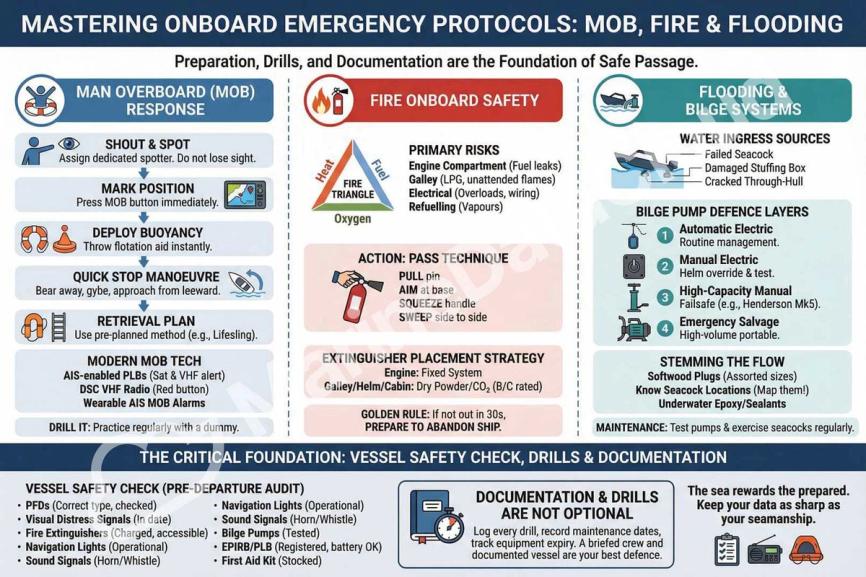
- Shout "Man Overboard!" — alert the entire crew immediately. Assign one crew member solely to spot and point at the person in the water (PIW). That spotter must not divert their gaze under any circumstances.
- Press the MOB button on your chartplotter or GPS immediately — this marks the precise GPS position of the incident.
- Deploy the horseshoe buoy, life ring, or danbuoy — throw something buoyant immediately to give the PIW something to cling to and to assist in maintaining visual contact.
- Execute the Quick Stop — bear away and gybe immediately, keeping the boat close to the PIW.
- Approach from leeward — always approach the PIW from the downwind or downcurrent side for greater manoeuvrability and to prevent the hull from drifting over the person.
- Retrieve the PIW — use a Lifesling, ladder, or dedicated recovery sling. Getting a person back aboard is often far harder than reaching them — plan your retrieval method in advance.
Modern MOB Technology: Your Digital Lifeline
Modern navigation and safety technology has transformed MOB response capability significantly:
- AIS-enabled PLBs (Personal Locator Beacons) — these transmit both a 406 MHz satellite distress signal and a VHF AIS signal, simultaneously alerting both rescue services and nearby vessels to the precise location of the person in the water. Devices such as the ACR ResQLink AIS represent the current state of the art.
- DSC (Digital Selective Calling) VHF Radio — pressing the red distress button transmits your vessel's MMSI number and GPS position automatically to all nearby vessels and coastguard stations.
- MOB Alarms via wearable AIS beacons — crew members wearing AIS MOB beacons allow the vessel's chartplotter to trigger an audible alarm and mark position automatically the instant they hit the water.
Skipper's Note: Ensure every PLB and EPIRB aboard is registered with the relevant national authority (e.g., OFCOM in the UK, NOAA in the USA). An unregistered beacon may trigger a response, but a registered one ensures rescue services have your vessel details, contact information, and emergency contacts before they even reach you.
Drill It, Don't Just Know It
Reading about MOB procedures is not enough. A crew that has never practised retrieval will freeze — guaranteed. Conduct MOB drills with a fender or bucket as your simulated PIW. Walk every crew member through their role. Time yourselves. Debrief afterwards. Then log the drill — noting the date, scenario, crew present, and any lessons identified. A documented drill history is not bureaucracy; it is proof of diligence and a tool for continuous improvement.
Part Two: Fire Onboard
Respect the Triangle
All combustion requires three elements: heat, fuel, and oxygen — the fire triangle. Remove any one element and the fire is extinguished. Onboard a boat, you have abundant fuel sources (diesel, petrol, LPG, upholstery, fibreglass), consistent oxygen, and multiple ignition risks (engines, galley, electrical systems). This makes prevention your most powerful fire-fighting tool.
Primary Fire Risks Aboard
- Engine compartment — fuel leaks, overheating, and electrical faults are the principal culprits. Ensure adequate ventilation before starting the engine after any period of inactivity.
- Galley — LPG and alcohol stoves require dedicated gas shut-off valves. Never leave a flame unattended.
- Electrical systems — overloaded circuits, corroded terminals, and poorly installed after-market equipment are silent fire hazards. Inspect wiring looms regularly.
- Refuelling — a critical moment of risk. Switch off all engines and ignition sources, prohibit smoking, and sniff the bilge for vapour before restarting.
Fire Extinguisher Selection and Placement
Marine fire extinguishers must be USCG-approved or equivalent to your national standard. The fundamental rule of placement is simple: an extinguisher must always be accessible from a position that is not within the fire zone.
Recommended placement strategy:
| Location | Fixed automatic BCF or CO₂ system |
| Galley | Dry powder or CO₂ (B/C rated) |
| Helm/cockpit | Dry powder B/C rated |
| Cabin/sleeping areas | Dry powder B/C rated |
| Anchor locker/foredeck | Dry powder B/C rated |
When using a handheld extinguisher, follow the PASS technique:
- Pull the pin
- Aim at the base of the flame
- Squeeze the handle
- Sweep side to side
Critical Rule: If a fire cannot be extinguished within the first 30 seconds, get everyone off the vessel. A boat is replaceable; your crew is not.
The Golden Rules of Onboard Fire Safety
- Keep engine bilges ventilated and gas-sniff before ignition.
- Install a fixed fire suppression system in the engine compartment if your budget allows.
- Check extinguisher pressure gauges and hydrostatic test dates as part of every pre-season maintenance cycle — and record the dates.
- Ensure all crew know the location of every extinguisher before departure.
- Have a clearly designated abandon ship protocol — know which flares, grab bag, and liferaft are where, and in what order to deploy them.
Part Three: Flooding and Bilge Pump Systems
Water Ingress — A Slower but Equally Deadly Threat
Unlike fire, flooding rarely announces itself dramatically. A failed seacock, a damaged stuffing box, a cracked through-hull fitting — water can begin entering a vessel quietly and accumulate before anyone notices. A vessel taking on 200 litres per minute will sink in a matter of hours; structural failure can accelerate this dramatically.
Understanding Your Bilge Pump System
A properly engineered bilge pump system comprises multiple layers of defence:
1. Automatic Electric Bilge Pump
The backbone of routine bilge management. Float-switch activated, it operates without crew intervention. Key specification: ensure the pump's flow rate matches your vessel's size. A 1,000 GPH (gallons per hour) pump is a baseline minimum for most cruising yachts; vessels over 40 feet should consider 2,500 GPH or greater.
2. Manual Electric Bilge Pump
A second switch at the helm allows the skipper to override and run the pump manually, regardless of float switch status. Essential for monitoring whether the automatic system is actually working.
3. High-Capacity Manual Hand Pump
When electrical systems fail — as they inevitably will in a serious flooding scenario — a manual diaphragm pump is your failsafe. The Henderson Mk5 and similar units can shift 25–30 litres per stroke. Position it where a crew member can operate it without moving below decks in deteriorating conditions.
4. Emergency High-Volume Salvage Pump
For serious ingress, a portable petrol-driven or high-capacity centrifugal pump can shift volumes that no built-in system can match. Some offshore cruisers carry these as standard.
Finding and Stemming the Source
Pumping is a holding measure, not a solution. The source of ingress must be identified and stemmed:
- Carry softwood damage-control plugs of assorted sizes, secured near through-hull fittings.
- Know the location and operation of every seacock on board — a closed seacock on a failed through-hull fitting buys critical time.
- Underwater epoxy putties and silicon sealants can buy additional time for a temporary repair underway.
Skipper's Note: Map every through-hull fitting, seacock, and associated pipe run, and record it. In a flooding emergency, a crew member who has never been below decks may need to find and close a seacock in the dark, in confused seas. Documentation is not paperwork — it is a lifeline.
Part Four: Emergency Position Reporting
The GMDSS Framework
The Global Maritime Distress and Safety System (GMDSS) is the international framework for distress communication at sea. Every recreational boater venturing offshore should understand its key components:
EPIRB (Emergency Position Indicating Radio Beacon)
The gold standard for vessel distress alerting. A Category 1 EPIRB activates automatically when it contacts water and floats free of a sinking vessel, transmitting on 406 MHz to the Cospas-Sarsat satellite network, with integrated GPS providing position accuracy within 100 metres. Registration is mandatory in most jurisdictions and critical to effective rescue.
PLB (Personal Locator Beacon)
Smaller and personally worn, a PLB is the individual equivalent of an EPIRB. Modern AIS-capable PLBs simultaneously broadcast on 406 MHz and AIS VHF, alerting both satellites and nearby vessels. Ideal for each crew member to carry, particularly during MOB risk scenarios in offshore or coastal passages.
DSC VHF Radio
A Mayday call on Channel 16, combined with a DSC distress alert, broadcasts your vessel's MMSI and GPS position to all vessels and coastal stations within VHF range (typically 20–40 nautical miles). Every crew member should know how to initiate a Mayday call — the format is standardised:
"Mayday, Mayday, Mayday — this is [vessel name, MMSI], position [GPS coordinates or bearing and distance from known point], nature of distress [MOB/fire/flooding], number of persons on board [X], require immediate assistance."
SART (Search and Rescue Transponder)
A radar transponder that responds to 9 GHz X-band radar with a distinctive pattern of concentric circles, allowing SAR aircraft and vessels to home in on your position. Increasingly being supplemented or replaced by AIS SARTs in modern fleets.
Part Five: The Vessel Safety Check — Your Pre-Departure Audit
A Vessel Safety Check (VSC) is a structured examination of your vessel's safety equipment and systems, typically taking 15–30 minutes. In the UK, the RYA and MCA provide guidance frameworks; in the USA, the US Coast Guard Auxiliary offers free VSC inspections.
The VSC Framework — What Must Be Checked
1. Personal Flotation Devices (PFDs)
- One approved lifejacket or buoyancy aid per person on board
- Correct rating for intended waters (50N for sheltered inland, 100N for coastal, 150N+ for offshore)
- Self-inflating PFDs: check gas cylinder weight, condition of oral inflation tube, and arm cord
- All PFDs fitted with crotch straps, lights, and whistle where appropriate
2. Visual Distress Signals
- Flares within date (UK: SOLAS-compliant, within four-year expiry)
- Orange smoke signals for daylight use
- Red parachute rockets and handheld flares for night use
- Location known to all crew
3. Fire Extinguishers
- Correct number and type for vessel size and propulsion
- Within hydrostatic test date and showing correct pressure
- Locations known to all crew
4. Navigation Lights
- All lights operational and within legal ranges for vessel size
- Spare bulbs or LED replacements carried
5. Sound-Producing Devices
- Whistle or horn capable of producing a 4-second blast audible at 0.5 nautical miles (for vessels under 12m)
6. Bilge Pump
- Automatic pump tested and operational
- Manual pump accessible and operable
7. Safety Harnesses and Jacklines
- Tethers and harnesses in good condition, correctly sized, and located for immediate access
- Jacklines rigged or readily deployable
8. EPIRB / PLB
- Registered, battery date valid, hydrostatic release in date (for EPIRB)
9. First Aid Kit
- Contents checked, medications in date
10. Documentation
- Ship's papers, registration, insurance certificate, and operator licences all current and aboard
Part Six: Briefing a Mixed-Experience Crew
Why This Is Non-Negotiable
The skipper may be the most experienced mariner on the water — but in a genuine emergency, they may be the one who is incapacitated, overboard, or occupied at the helm. Every person aboard must know the basics, regardless of their sailing experience. The pre-departure safety briefing is your opportunity to ensure that a first-time crew member is not helpless when seconds matter.
Structure of an Effective Pre-Departure Briefing
Deliver your briefing at the dock, before departure — not underway with the engine running and distractions competing for attention.
Stage 1 — Orientation (5 minutes)
Walk every crew member through the vessel's layout:
- Location of all hatches and companionway exits
- Location of fire extinguishers, flares, and grab bag
- Location of all seacocks and how to close them
- Location of liferaft and EPIRB
Stage 2 — PFD and Harness Fitting (5 minutes)
Every crew member should don and adjust their own PFD — do not assume they know how to fit it correctly. Demonstrate how to activate an auto-inflating PFD manually if it fails to self-inflate. For offshore passages, explain harness and tether use, and when to clip on.
Stage 3 — MOB Drill Walkthrough (5 minutes)
Tell every crew member: "If someone goes overboard, shout 'Man Overboard', point and keep pointing. Do not jump in. Throw this horseshoe buoy. Press this button on the chartplotter. Then call for me." Simple. Repeatable. Memorable.
Stage 4 — Fire and Flooding (5 minutes)
- Show the location and operation of the nearest fire extinguisher
- Explain the PASS technique briefly
- Show the bilge pump switch and how to recognise if the bilge alarm activates
- Explain the golden rule: if in doubt, get out
Stage 5 — Mayday and Distress Signals (3 minutes)
Show crew the VHF radio, explain Channel 16, and leave a laminated Mayday script beside the radio. Demonstrate how to press the DSC distress button. Show where the flares are stored.
Stage 6 — Questions and Confirmation
Invite questions. A crew member who asks a "basic" question is a crew member who is paying attention. Never discourage it.
Captain's Log: After each briefing, note the date, vessel, crew present, and topics covered. In the event of an incident or an insurance claim, a documented briefing history may carry significant weight.
The Thread That Ties It All Together: Documentation and Drills
We have covered a great deal of technical ground in this post — MOB procedures, fire management, bilge systems, distress alerting, VSC frameworks, and crew briefings. But here is the truth every experienced skipper knows: none of it works reliably without documentation and practice.
A fire extinguisher with an expired hydrostatic test date may fail when you need it most. An EPIRB with a flat battery is worthless. A seacock that has never been exercised may be seized open precisely when flooding demands it be shut. A crew member who was briefed eighteen months ago and has never rehearsed may freeze.
This is the argument we made in a previous post: organised data management is not an administrative convenience — it is a safety system. When you catalogue every piece of safety equipment, log every maintenance task, record every expiry date, and track every drill, you are not filling in forms. You are building a vessel that is genuinely prepared for whatever the sea presents.
Your logbook, your maintenance records, your equipment registers — these are the charts by which you navigate safety. Keep them updated, keep them accessible, and review them before every voyage.
The sea rewards the prepared. It rarely forgives the negligent.
Cruise safe — and keep your vessel's data as sharp as your seamanship.