Above the Waterline: A Complete Guide to Rigging, Masts & Sail Plans
Look Up — The Rig Is Where Sailing Lives
Every experienced sailor knows that a boat's soul lives not in her bilges, but aloft. The mast, the rigging, and the sail plan are the engine, the gearbox, and the steering system all rolled into one magnificent, wind-driven assembly. If the hull is a boat's body, then the rig is undeniably her spirit. Understanding what sits above the waterline — how it is supported, how it works, and why different configurations suit different voyages — is one of the most rewarding areas of nautical knowledge a mariner can master.
Standing Rigging: The Architecture of Support
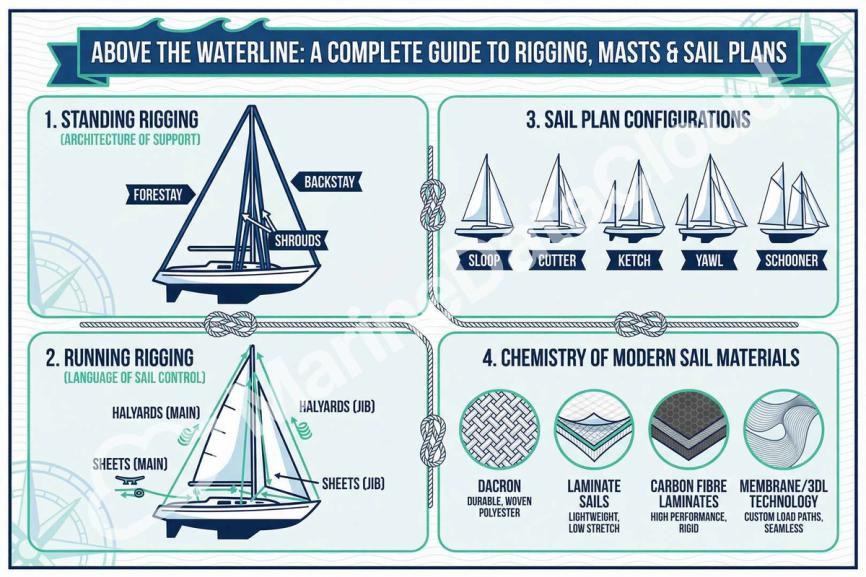
Before a sail can draw wind, the mast must stand. That task falls to the standing rigging — the fixed network of wires, rods, or modern fibre lines that hold the spar in place. The standing rigging comprises the forestay (running from the masthead to the bow), the backstay (leading aft to the transom or quarters), and the shrouds (lateral supports running to the chainplates on either side of the hull). On fractional rigs, which became popular through the influence of racing yacht designers in the latter half of the 20th century, the forestay attaches below the masthead, allowing the mast to bend under backstay tension and the mainsail shape to be actively tuned.
Traditionally, standing rigging was fabricated from 1×19 stainless steel wire — nineteen individual strands wound into a single cable. Today, rod rigging offers lower stretch and reduced windage, whilst high-tech alternatives such as Dyneema (UHMWPE) and PBO (Polybenzobisoxazole) fibre provide extraordinary tensile strength at a fraction of the weight. A full re-rig interval of 7–10 years is widely recommended for bluewater cruisers, though racing yachts operating under extreme load may inspect and replace rigging far more frequently.
Running Rigging: The Language of Sail Control
If standing rigging is the skeleton, running rigging is the muscular system — the dynamic lines that hoist, trim, reef, and furl every sail aboard. The halyards raise the sails; the sheets control their angle to the wind; the boom vang (or kicker) governs boom height and leech tension; the cunningham adjusts luff tension; the outhaul flattens or deepens the mainsail foot. On a modern cruising yacht, a well-organised running rigging system may lead two dozen or more lines aft to the cockpit, giving the crew full control without leaving the safety of the helm position.
Modern running rigging has been transformed by high-modulus synthetic fibres. Halyards constructed from Dyneema core with polyester cover have displaced wire-to-rope hybrids on all but the most traditional vessels. Vectran offers exceptional strength with minimal creep, making it ideal for sheets and control lines where consistent trim is critical. Understanding the stretch characteristics of each line material is not merely academic — on a long offshore passage, a stretchy halyard will cost you sail shape, boat speed, and ultimately, time at sea.
Sail Plan Configurations: Choosing Your Rig
The arrangement of masts and sails — the sail plan — is one of the most consequential design decisions in yacht architecture. Each configuration carries distinct advantages in terms of sail area, balance, ease of handling, and windward performance.
The Sloop
The sloop is the world's most popular cruising and racing rig, featuring a single mast carrying a mainsail and one headsail. Its simplicity is its genius: fewer spars, fewer lines, less weight aloft, and an aerodynamically efficient sail plan that excels to windward. The fractional sloop, popularised by racing designers including the teams behind the America's Cup campaigns of the 1980s and 1990s, allows precise mast-bend control and dominates the performance cruiser market.
The Cutter
A cutter carries a single mast positioned further aft than a sloop's, allowing two headsails — typically an inner staysail and an outer genoa or yankee — to be set simultaneously. This versatility makes the cutter an enduring favourite for offshore passage-making, as the sail plan can be broken into smaller, more manageable components in heavy weather. The cutter rig has a long and distinguished pedigree in British sailing tradition, featuring prominently in the great pilot cutters of the Bristol Channel and the revenue cutters of the 18th century.
The Ketch
The ketch divides its sail plan across two masts — the taller mainmast forward, and a shorter mizzen mast stepped forward of the rudder post. The split sail plan allows smaller, lighter individual sails, reducing crew fatigue on short-handed passages. Ketches became especially popular for bluewater cruising from the 1960s onwards, with designs such as the Sparkman & Stephens-penned ocean cruisers exemplifying the type. The mizzen can be used independently in combination with a headsail — the so-called "jib-and-jigger" arrangement — a useful storm configuration when conditions deteriorate.
The Yawl
Often confused with the ketch, the yawl is distinguished by its mizzen mast being stepped aft of the rudder post, resulting in a proportionally smaller mizzen sail. The yawl's mizzen contributes modestly to propulsion but serves valuably as a balancing sail, helping to keep the helm light in varying conditions. The type enjoyed a golden era in American offshore racing during the 1950s and 1960s, with the CCA (Cruising Club of America) rule favouring its proportions.
The Schooner
With its foremast shorter than the mainmast, the schooner is a thoroughbred of the reaching and running passages. Two or more masts carry a combination of fore-and-aft sails and, on traditional topsail schooners, square topsails for downwind work. The schooner rig dominated North American coastal trade in the 18th and 19th centuries, with the six-masted Wyoming — launched in 1909 and measuring 449 feet — representing the pinnacle of the type. Today, schooners remain popular as charter vessels and in classic yacht racing, their graceful sail plans rewarding skilled trim in trade-wind conditions.
The Chemistry of Modern Sail Materials
A sail is not merely a sheet of fabric — it is a precision-engineered aerofoil whose shape determines the lift generated and, consequently, the speed and pointing ability of the yacht. The evolution of sailcloth over the past 70 years represents one of the most dramatic material science stories in all of sport.
Dacron: The Reliable Workhorse
Introduced commercially in the early 1950s, Dacron (woven polyester) rapidly replaced natural cotton and flax as the standard sailcloth. Its virtues are considerable: moderate stretch, good UV resistance, straightforward repairability, and an accessible price point. For cruising sailors prioritising longevity over outright performance, a well-made Dacron mainsail can deliver 10–15 years of reliable service. Dacron remains the default choice for the majority of production cruising yachts delivered today.
Laminate Sails: Shape Retention Under Load
The development of laminate sailcloth in the 1970s and 1980s, pioneered by sail makers including North Sails, transformed offshore racing. Laminates bond structural load-bearing fibres — Kevlar (aramid), Spectra, Dyneema, or carbon — between films of Mylar (biaxially-oriented polyester film), creating a cloth that resists deformation under load far more effectively than woven fabrics. The result is a sail that retains its designed aerofoil shape across a wide wind range, translating directly into improved upwind performance and VMG (Velocity Made Good).
Carbon Fibre Laminates: Racing's Cutting Edge
At the apex of sail technology, carbon fibre laminate sails deliver exceptional stiffness-to-weight ratios and near-zero stretch under racing loads. Carbon sails are engineered with load paths mapped to the exact stresses experienced under sail, with fibres oriented precisely along those paths. The trade-off is cost — a full carbon racing wardrobe can exceed the value of many cruising yachts — and durability, as carbon fibres are susceptible to the fatigue of repeated folding. They are the province of grand prix racing and fully-crewed offshore programmes.
Membrane and 3DL Technology
The most sophisticated modern sails are not laminated at all in the traditional sense. 3DL (Three-Dimensional Laminate) technology, developed by North Sails in the 1990s, moulds a complete sail as a single continuous membrane over a three-dimensional form, embedding load-bearing fibres precisely along the stress paths of the flying sail shape. The resulting structure has no seams in the traditional sense and exhibits outstanding shape stability across all wind angles.
Why Your Rig Configuration Matters as Much as Your Hull
Naval architects have long understood that hull and rig must be designed as an integrated system. A deep, heavy-displacement hull with high initial stability can support a generous sail area and a taller rig without compromising safety. A light-displacement flyer demands a carefully balanced rig to avoid overpowering in a breeze. The centre of effort of the sail plan must be positioned in precise relationship to the centre of lateral resistance of the underwater hull — the distance between these two points, known as lead, determines whether the boat carries weather helm, lee helm, or sails in perfect balance.
Understanding your rig — its strengths, its limitations, and its optimal wind range — is not merely a matter of academic interest. It is the difference between a challenging passage and an effortless one, between arriving fatigued and arriving invigorated. The seasoned sailor who truly knows their rig sails with confidence, efficiency, and, above all, safety.
Summary: Key Takeaways for the Technically Minded Sailor
- Standing rigging supports the mast through forestays, backstays, and shrouds; modern materials include 1×19 wire, rod rigging, Dyneema, and PBO fibre.
- Running rigging controls sail shape and position via halyards, sheets, vangs, and more; high-modulus synthetics such as Dyneema and Vectran have transformed line performance.
- The sloop offers the simplest, most windward-efficient rig for cruising and racing; the cutter adds headsail versatility for offshore work.
- The ketch and yawl split the sail plan for easier handling short-handed, with the mizzen mast positioned fore (ketch) or aft (yawl) of the rudder post.
- The schooner excels on reaching and downwind passages, with a proud heritage in commercial and coastal sailing history.
- Dacron remains the durable, affordable, and serviceable workhorse of cruising sailcloth.
- Laminate and carbon fibre sails deliver superior shape retention and performance at the cost of longevity and price.
- 3DL membrane technology represents the current pinnacle of sail construction, moulding a complete aerofoil with precisely oriented load-bearing fibres.
- Rig configuration, sail material, and hull design must always be evaluated as an integrated system, not in isolation.