Fibreglass, Aluminium, Wood or Steel? A Captain's Guide to Boat-Building Materials
What Your Hull Is Really Made Of — and Why It Matters
Every mariner worth their salt knows that a boat is only as good as its hull. Whether you're scanning the pontoons at a yacht show, eyeing up a bluewater cruiser on a brokerage listing, or planning a build from scratch, the question of hull material is one of the most consequential decisions you'll ever make as a skipper. It shapes everything downstream: performance, maintenance schedule, resale value, repair costs, and where in the world you can confidently take your vessel.
In our previous post, we explored hull forms and how the shape of a hull determines how a boat moves through water. Now it's time to go deeper — right down to the molecular and metallurgical level — and examine what those hulls are actually built from. From the ubiquitous GRP fibreglass yacht to the elite carbon fibre racing machine, each material tells a different story. Let's chart the course.
GRP (Glass-Reinforced Plastic): The Workhorse of Modern Boatbuilding
Glass-reinforced plastic, commonly known as fibreglass or GRP, has dominated recreational boatbuilding since the 1950s, when American manufacturer Owens Corning pioneered its mass-market application. By the 1960s, production boatyards across Britain, Europe, and the United States had largely abandoned timber in favour of GRP for its mouldability, low initial production cost, and relatively low maintenance requirements.
At its core, GRP is a composite material: woven or chopped glass fibres are embedded in a resin matrix — typically polyester, vinyl ester, or epoxy — to produce a material that is simultaneously strong, lightweight, and resistant to water. The resin provides stiffness and water resistance, whilst the fibres carry tensile loads. Modern GRP hulls frequently incorporate a sandwich construction, with a foam or balsa core laminated between two GRP skins, dramatically increasing stiffness-to-weight ratio without adding significant mass.
Durability: A well-built GRP hull can last 30–50 years or more. The primary long-term threat is osmotic blistering — a process whereby water molecules permeate the gel coat and react with the laminate, forming blisters beneath the waterline. Epoxy barrier coats mitigate this risk considerably.
Maintenance: Moderate. Annual antifouling, periodic gel coat repairs, and osmosis treatment when required. GRP is largely corrosion-free, which gives it a significant edge over metallic hulls in temperate and tropical waters.
Repair costs: Relatively low. Fibreglass repair is well understood, and materials are widely available in most marinas worldwide. Structural repairs to cored panels can be more complex and costly.
Best suited for: Coastal cruising, offshore bluewater sailing, racing yachts, production powerboats, and family sailing — essentially the broadest possible range of sailing environments.
Marine-Grade Aluminium: Lightweight Strength for the Serious Offshore Sailor
Aluminium entered mainstream boatbuilding in earnest during the 1970s and 1980s, quickly becoming the material of choice for high-latitude expedition yachts and performance cruising vessels. The alloys used in marine construction — principally 5083, 5086, and 6061 — are specifically formulated to resist saltwater corrosion. Alloy 5083 is the benchmark for hull plating, offering exceptional toughness, weldability, and resistance to seawater attack, even in polar conditions.
Metallurgically, aluminium's appeal lies in its high strength-to-weight ratio. A marine-grade aluminium hull is typically 15–20% lighter than an equivalent GRP hull, and up to 35–40% lighter than steel — a critical advantage for speed, fuel economy, and payload capacity. The metal forms a natural oxide layer that acts as a passive corrosion barrier, though galvanic corrosion remains a serious risk if dissimilar metals come into contact without proper isolation.
Durability: Outstanding. Aluminium hulls withstand impact well — significantly better than GRP — and are the favoured choice for ice-capable cruising yachts navigating high-latitude waters such as the Northwest Passage or Antarctic Peninsula.
Maintenance: Low to moderate. No antifouling paint is required above the waterline. Below the waterline, specialist antifouling systems must be used, as copper-based antifouling reacts galvanically with aluminium and will accelerate corrosion. Electrolysis management via sacrificial anodes is essential.
Repair costs: Moderate to high. Aluminium welding requires specialist skills and equipment, though the material is highly repairable, and structural repairs are not uncommon on expedition vessels that have encountered ice or debris.
Best suited for: Bluewater ocean cruising, high-latitude and polar voyaging, expedition yachts, performance motorsailers, and commercial workboats.
Cold-Moulded Timber: The Craftsman's Hull
Wood is the oldest boatbuilding material known to humanity — a fact that makes it easy to dismiss as anachronistic. That would be a grave navigational error. Cold-moulded timber, a technique refined through the latter half of the 20th century, has produced some of the finest offshore racing and cruising yachts ever built.
The process involves laminating multiple thin veneers of timber — typically Western red cedar, mahogany, or Douglas fir — at opposing diagonal angles over a mould or framework, bonding them with epoxy resin using the WEST System or similar modern adhesive technologies. The result is a hull that is monocoque in nature: extraordinarily stiff, light, and structurally homogeneous. Unlike traditional carvel or clinker planking, cold-moulded hulls have no caulked seams and do not rely on the wood swelling to become watertight.
Durability: Excellent when properly maintained and protected. Epoxy-saturated cold-moulded hulls are highly resistant to rot and moisture ingress. Without maintenance, however, degradation can be rapid.
Maintenance: High. The Achilles' heel of any timber hull is moisture management. Annual varnishing or painting, rigorous inspection for delamination, and vigilant antifouling are non-negotiable. Owners must be committed to their vessel.
Repair costs: High, and highly skilled-labour dependent. Finding craftsmen capable of quality cold-moulded repair is increasingly challenging. That said, timber repairs — unlike some composite technologies — can be executed with relatively basic tools in remote locations.
Best suited for: Custom one-off builds, traditional sailing enthusiasts, classic yacht restoration, and racing yachts where weight is paramount and skilled maintenance is guaranteed.
Ferro-Cement: The Budget Builder's Gamble
Ferro-cement is one of maritime history's most misunderstood materials. Invented by French engineer Joseph-Louis Lambot in the 1840s — who famously built a ferro-cement rowing boat that still exists today — the technique involves plastering a rich Portland cement mortar over a closely spaced armature of steel rods and wire mesh. When executed to a professional standard, the result is a hull that is fire-resistant, seamless, and remarkably impact-tolerant.
The material's downfall, historically, has been the amateur builder. The 1960s and 1970s saw a proliferation of DIY ferro-cement projects inspired by books such as John Samson's Ferro Cement — many of which resulted in poorly plastered, overweight hulls with inadequate steel coverage, leading to the material's enduring poor reputation.
Durability: Potentially excellent if professionally built. A correctly constructed ferro-cement hull is homogeneous, seamless, and highly resistant to marine borers. Poor builds, however, suffer from internal steel corrosion that bleeds rust through the hull surface.
Maintenance: Moderate to high. Monitoring for cracks, treating any rust bleeding, and maintaining coatings is ongoing. Surveying ferro hulls requires specialist knowledge and is often problematic for insurance underwriters.
Repair costs: Low to moderate for surface repairs; structurally complex repairs are another matter entirely. Critically, ferro-cement boats frequently suffer poor resale values due to insurer reluctance and buyer wariness — a practical financial consideration.
Best suited for: Budget long-range cruising builds supervised by experienced professionals. Not recommended for first-time buyers without specialist survey support.
Carbon Fibre Composites: The Performance Pinnacle
At the apex of modern boatbuilding materials sits carbon fibre reinforced polymer (CFRP) — the material of choice for grand prix ocean racers, superyachts, and elite performance cruisers. Carbon fibre composites consist of extremely fine carbon filaments — each approximately 5–10 micrometres in diameter — woven into fabrics and infused with high-performance epoxy resins, typically under vacuum infusion or pre-preg manufacturing processes.
The mechanical properties are extraordinary. Carbon fibre has a tensile strength approximately five times that of structural steel at roughly one-fifth of the weight. This translates directly into hulls that are stiffer, lighter, and faster than any alternative — qualities that define the modern IMOCA 60, Vendée Globe monohull, and high-performance superyacht platforms.
Durability: High in controlled conditions, but carbon fibre is more notch-sensitive than GRP or aluminium. Impact damage — from collisions with flotsam, container debris, or whales (a genuine offshore hazard) — can cause structural delamination that is invisible to the naked eye yet catastrophic in structural terms.
Maintenance: Low in terms of corrosion (carbon fibre does not rust or suffer osmosis), but critical in terms of structural inspection. Post-impact ultrasonic or tap-testing surveys are essential. Additionally, carbon fibre is galvanically noble — contact with aluminium fittings without proper isolation causes rapid galvanic corrosion of the metal component.
Repair costs: Very high. CFRP repair requires specialist laminators, controlled-temperature post-cure environments, and expensive materials. This is not a repair you undertake in a third-world marina with a tin of resin and a roll of cloth.
Best suited for: Offshore racing yachts, performance multihulls, superyachts, and serious bluewater performance cruisers where budget is not the primary constraint.
Summary: Choosing Your Hull Material — Key Takeaways
Navigating the world of boat-building materials need not feel like sailing blind into fog. Here are the essential waypoints to carry with you:
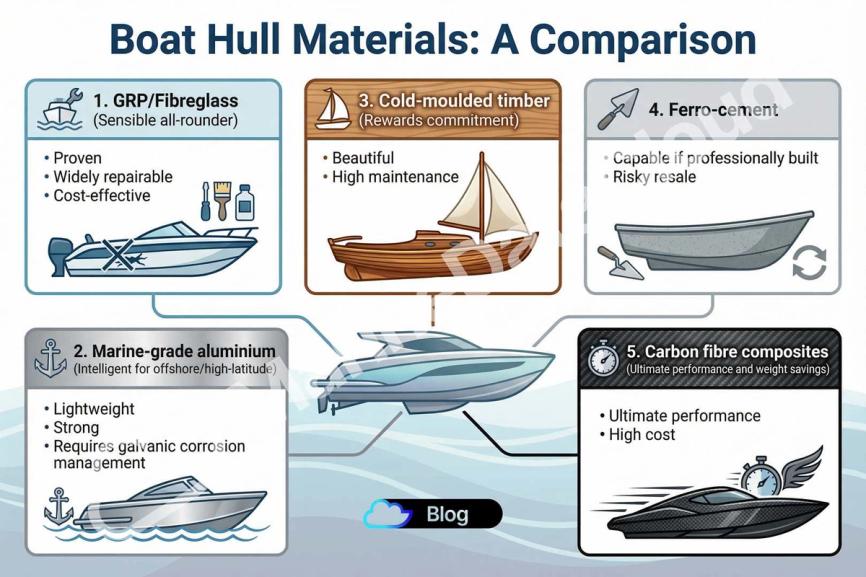
- GRP/Fibreglass is the sensible all-rounder — proven, widely repairable, cost-effective, and suited to the vast majority of recreational sailors. Look for epoxy-infused laminate and a proper osmosis barrier coat.
- Marine-grade aluminium (alloy 5083 or 5086) is the intelligent choice for serious offshore and high-latitude voyagers. Lightweight, strong, and durable — but galvanic corrosion management is non-negotiable.
- Cold-moulded timber rewards commitment with beauty and performance. It demands an owner who is as passionate about maintenance as they are about sailing.
- Ferro-cement, when professionally built, is more capable than its reputation suggests — but buyer beware: survey carefully, understand the insurance landscape, and temper expectations on resale.
- Carbon fibre composites deliver the ultimate in performance and weight savings, but at a cost — financial and practical — that places them firmly in the realm of the serious racing and superyacht market.
Understanding what your boat is made of is not merely an academic exercise. It informs every maintenance decision, every insurance conversation, every refit budget, and ultimately every mile you sail with confidence. The best captains don't just know where they're going — they know exactly what vessel is carrying them there.