Paper Logs vs. Digital Management: The Great Debate in Modern Boating
Paper Logs vs. Digital Management: The Great Debate in Modern Boating
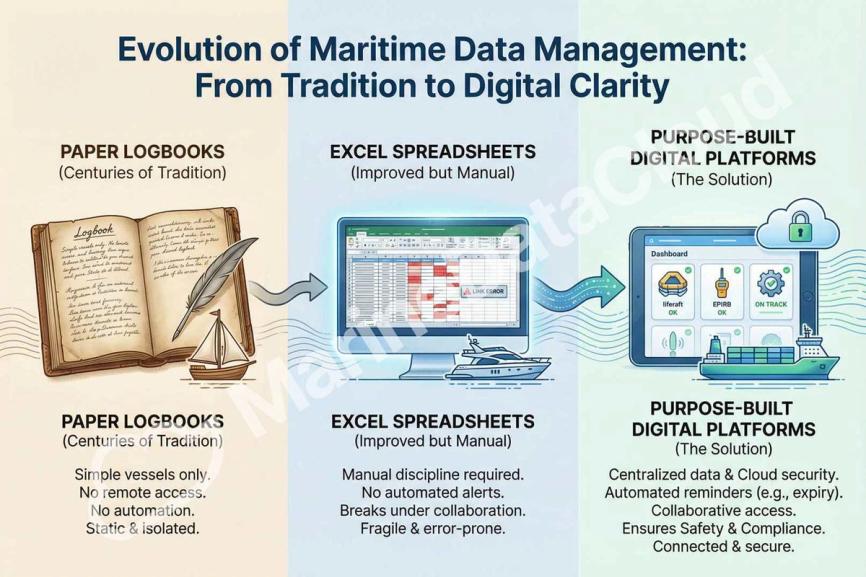
There is something undeniably romantic about a well-worn logbook. Leather-bound, salt-stained at the edges, filled with handwritten entries in the careful script of a conscientious skipper — the nautical logbook is one of seafaring's most enduring traditions. Dating back centuries, the ship's log has served as the official chronological record of a vessel's life: her voyages, her crew, her mechanical heartbeat. From the deck logs of the Royal Navy to the meticulously kept journals of whaling masters in New Bedford, the paper logbook is woven into the very fabric of maritime culture.
But nostalgia, however well-earned, does not keep your safety equipment certificates current. And sentiment won't remind you that your flare kit expired last March.
The Charm of the Notebook — and Why It Earns Its Place
Let us be honest: there is a genuine pleasure in opening a physical logbook at the chart table, pen in hand, and recording the day's passage. Position at 1400, wind force 4, engine hours 1,847, barometric pressure steady. It is tactile, immediate, and entirely yours. For solo sailors and weekend cruisers managing a straightforward vessel, a quality paper log remains a perfectly valid tool. It requires no battery, no Wi-Fi, no software update, and no subscription. It simply works.
Many experienced mariners — bluewater cruisers, classic yacht owners, coastal racers — will defend their notebooks fiercely, and rightly so. A paper log is also legally admissible evidence of a vessel's activity in many jurisdictions, providing a timestamped, human-authored record that carries genuine weight in insurance claims and incident investigations.
The tradition is real. The value is real. But the limitations, as any honest captain will admit, are equally real.
The Excel Era: Ingenious, but Built for a Different Voyage
When personal computing transformed the 1990s, forward-thinking boat owners graduated from the notebook to the spreadsheet. Microsoft Excel became the unofficial fleet management system of the ambitious amateur mariner. Columns for maintenance intervals, rows for equipment inventory, conditional formatting to flag overdue service tasks — it was genuinely clever, and it represented a significant step forward.
The spreadsheet-savvy skipper could build a sophisticated workbook: one tab for the engine, another for safety gear, a third for crew certifications, a fourth for insurance and registration documents. With enough time, enough formulas, and enough discipline, you could construct something impressively functional.
The problem is that very word: discipline. A spreadsheet demands relentless manual upkeep. It does not send you a notification at 0800 telling you that your EPIRB battery registration lapses in fourteen days. It does not alert your delivery skipper that the vessel's insurance certificate expires before his passage date. It does not cross-reference your service history with your manufacturer's warranty conditions, or automatically flag that the last antifouling was applied nineteen months ago and the hull is overdue.
Where Both Methods Begin to Take on Water
As vessel complexity scales — twin engines, watermakers, generators, AIS transponders, liferaft service contracts, crew medical certificates, port authority documentation, flag state compliance — the cracks in both systems widen into genuine hazards.
Collaboration is the first casualty. A paper log lives aboard the boat. An Excel file lives on someone's laptop. Neither is accessible to the marina manager coordinating a refit, the insurance broker requesting updated certificates, the professional skipper joining for a charter, or the co-owner three hundred miles away who wants to check whether the fuel filters were changed before their upcoming passage.
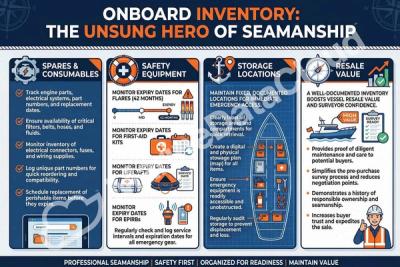
Expiry tracking becomes a liability. Safety equipment — liferafts, flares, EPIRBs, fire extinguishers — all carry strict certification and service intervals mandated by flag state regulations and SOLAS standards. Missing a single expiry date is not merely inconvenient; it can invalidate your insurance policy, render your vessel non-compliant for a coastal passage, or, in the gravest scenario, leave you at sea with equipment that will not perform when your life depends on it.
Cross-referencing is practically impossible at scale. Which engine service triggered the gearbox inspection? What was the sea temperature and engine load profile during last summer's overheating incident? Paper logs and spreadsheets store data in isolation. They do not speak to one another, and drawing meaningful operational intelligence from them requires hours of manual cross-referencing.
Version control is a ghost ship. When two people update different copies of the same Excel workbook, the result is not a record — it is a source of dangerous confusion. Which version is current? Who changed the hydrostatic release replacement date, and when?
Making the Case for Purpose-Built Digital Platforms
The purpose-built marine management platform exists precisely because a boat is not a business and not a household — it is a vessel, with unique regulatory obligations, safety-critical equipment, and operational demands that generic tools simply were not designed to address.
A dedicated platform built around the realities of boat ownership and operation centralises every aspect of vessel data in a single, secure, always-accessible environment. Certificates, documentation, maintenance records, voyage logs, equipment inventories, crew records, insurance policies, and compliance deadlines — all interconnected, all searchable, all protected by cloud backup, and all available to every authorised user regardless of their location.
Automated reminders replace the silent ticking of a spreadsheet nobody checks. Structured data fields replace the interpretive challenge of handwritten margin notes. Collaborative access replaces the single-point-of-failure of one person's filing system. And because the platform is built specifically for the marine environment, every category, every data field, and every workflow reflects the actual language and logic of boat ownership — not the logic of a generic productivity tool repurposed for the waterfront.
The paper logbook earned its place in maritime history. The Excel spreadsheet earned its moment as a clever workaround. But when your vessel's safety, compliance, and operational continuity are at stake, the question is no longer whether to go digital — it is whether you are using a tool that was actually built for the sea.
Navigate smarter. Keep every detail shipshape. The horizon is digital, and it is already within reach.
Summary: Key Takeaways
- Paper logbooks carry centuries of maritime tradition and remain useful for simple, single-handed or low-complexity vessels, but they are inaccessible remotely, non-collaborative, and incapable of automation.
- Excel spreadsheets were a genuine improvement in boat data management but require constant manual discipline, offer no automated alerts, break down under collaborative use, and create dangerous version-control issues.
- Expiry tracking for safety-critical equipment (liferafts, EPIRBs, flares, extinguishers) is one of the most serious failure points of both paper and spreadsheet systems — missed deadlines carry legal, insurance, and safety consequences.
- Vessel complexity is the scaling problem: the more systems, certificates, crew, and co-owners involved, the more urgently a purpose-built platform is needed.
- Purpose-built digital platforms offer centralised data, automated reminders, collaborative access, cloud security, and marine-specific data structures that no generic tool can replicate.
- The future of responsible boat ownership is not paperless for nostalgia's sake — it is digital for safety, compliance, and clarity.