Hull Truth: How to Choose the Right Boat Hull for the Way You Sail
The most consequential decision any mariner makes isn't the engine, the electronics, or the sails — it's the shape of the hull beneath your feet!
Setting the Course
Every voyage begins below the waterline. Before you debate chartplotters, autopilots, or sail plans, there is one fundamental question that will define every passage you ever make, every fuel bill you ever pay, and every sea state you either conquer or endure: what hull are you sailing on?
Think of the hull as your boat's keel card — the single document that governs everything else in your vessel's performance profile. Get it right, and you have a platform perfectly tuned to the waters you frequent. Get it wrong, and no amount of additional hardware or horsepower will correct the mismatch between your boat and your ambitions.
This is the first instalment of our technical series on boat design, and we're starting where every naval architect starts — at the hull. We'll decode the three primary hull modes, break down hull cross-sections, and then compare the grand debate of our era: monohulls versus catamarans versus trimarans. By the end, you'll understand precisely why hull choice is the most consequential decision any boat owner makes.
Part One: The Three Modes of Movement — How Hulls Interact With Water
Before examining specific hull shapes, you need to understand the three fundamental modes in which a hull operates. These are not just technical categories — they are entirely different physical relationships with the sea itself.
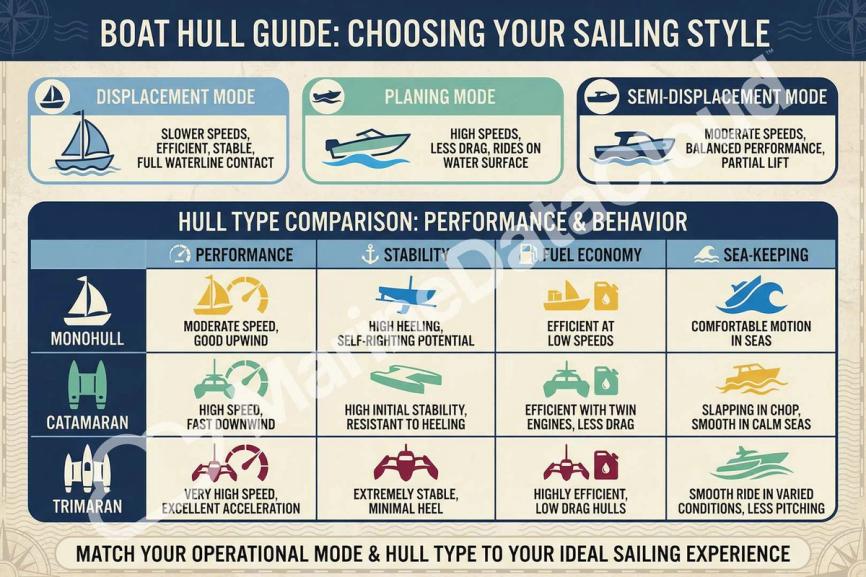
1. Displacement Hulls — The Ocean Voyager's Foundation
A displacement hull sits in the water, pushing it aside as it moves forward. At no point does the hull lift clear of the surface — it simply displaces a volume of water equal to its own weight, which is why Archimedes' principle governs its entire existence.
The governing physics: Hull Speed
Displacement hulls are constrained by what naval architects call hull speed — the theoretical maximum speed at which a displacement vessel can efficiently operate. The classic formula, derived from wave-making resistance, is:
Vhull=1.34×LWL
Where Vhull is in knots and LWL is the waterline length in feet. A 40-foot waterline, therefore, produces a theoretical hull speed of approximately 8.5 knots.
This is not merely a guideline — it reflects a physical reality. As a displacement hull approaches hull speed, its bow wave lengthens until the wavelength equals the waterline length. The boat effectively becomes trapped in a trough between its own bow and stern waves, requiring exponentially more power for any incremental speed gain. You can push past hull speed, but the energy cost is punishing.
The Froude Number — the deeper truth
Naval architects use the dimensionless Froude number (Fn) to express this relationship more precisely:
Fn=gLV
Where V is velocity, g is gravitational acceleration, and L is waterline length. Displacement hulls operate efficiently at Fn below approximately 0.4. Once Fn climbs toward 0.5 and beyond, wave-making resistance dominates, and you are fighting physics rather than working with it.
Characteristics at a glance:
- Speed range: Typically 5–9 knots for a 35–50 ft vessel
- Fuel efficiency: Excellent — the lowest fuel burn per nautical mile of any motorised hull type
- Sea-keeping: Outstanding — the deep, heavy form provides inherent roll damping and predictable motion in open water
- Range: Maximum — ideal for bluewater passagemaking
- Typical vessels: Full-keel sailing yachts, ocean trawlers, long-range cruisers, traditional workboats
Real-world performance note: A typical 45-foot displacement trawler yacht burning 3–4 litres per nautical mile at 7 knots will return ranges of 1,500–2,500 nautical miles from a single fuel load — a capability no planing hull of comparable size can approach.
2. Planing Hulls — The Thrill of Flying on Water
A planing hull operates on an entirely different principle. Rather than pushing through water, a planing hull generates hydrodynamic lift that raises the bow and allows the hull to skim across the surface at speed. The transition from displacement to planing mode — commonly called "getting on the plane" — is one of the most dramatic performance events in boating.
The physics of planning:
At low speeds, a planing hull behaves like a displacement hull, sitting deep in the water with high drag. As speed increases, dynamic lift builds under the forward sections of the hull, the bow rises (the characteristic "bow rise" phase), and eventually the hull breaks free of its own bow wave. Above planing threshold, hydrodynamic lift supports most of the vessel's weight, dramatically reducing wetted surface area and therefore drag.
Planing threshold typically occurs at Fn > 1.0–1.2, equivalent to speed-length ratios of roughly 3.0+ for most hull forms.
Hull cross-sections that enable planing:
- Flat bottom: Maximum lift generation, excellent for calm water, but brutal in chop — the hull slaps wave faces hard and transmits shock directly to crew and structure. Common on small river craft, tenders, and some bass boats.
- Deep-V (deadrise 20–24°): The ocean performance standard. The sharp V entry slices through waves rather than slamming against them, offering far superior sea-keeping at speed. At the transom, significant deadrise is maintained, giving the hull progressive lift and a drier, more controlled ride.
- Modified V / variable deadrise: Combines the lift efficiency of a flatter section aft with the wave-piercing ability of a sharp V forward. The most common configuration on modern performance cruisers and sportfishers.
Characteristics at a glance:
- Speed range: 18–50+ knots depending on power-to-weight ratio
- Fuel efficiency: Poor at planing speeds — fuel consumption increases with the cube of speed. Doubling speed roughly quadruples fuel burn
- Sea-keeping: Highly dependent on hull design; deep-V hulls manage moderate seas well but at high speed in heavy seas, even a well-designed planing hull delivers a punishing ride
- Range: Limited — high fuel burn restricts offshore range severely
- Typical vessels: Sportboats, RIBs, sportfishers, day cruisers, speedboats, patrol craft
The planner's paradox: A planing hull is simultaneously the most exciting and least efficient way to travel by sea. At 30 knots, you'll burn fuel at a rate that makes a diesel Land Rover look frugal. The moment you throttle back to displacement speeds, your efficiency improves dramatically — but then you're hauling around hull volume and weight that was designed for speed, not economy.
3. Semi-Displacement (Semi-Planing) Hulls — The Intelligent Compromise
The semi-displacement hull is perhaps the most intellectually honest design in the naval architect's portfolio — a form that acknowledges the real-world truth that most boat owners want both comfort at sea and the ability to make reasonable passage speeds without bankrupting themselves on fuel.
A semi-displacement hull operates efficiently in both the upper displacement range and into the early planing regime. It is neither fully planing nor purely displacement — it generates partial hydrodynamic lift that pushes its practical speed ceiling significantly beyond the theoretical hull speed of a comparable displacement form, without requiring the extreme power-to-weight ratios of a true planing hull.
The key design feature: A semi-displacement hull typically has a similar profile to a displacement hull forward but flattens progressively toward the stern, allowing partial lift to develop without full planing transition. The stern sections are often broader and flatter than a pure displacement design, and the underwater run aft is engineered to generate lift rather than simply clear water from the path.
Performance advantage: A semi-displacement hull can achieve approximately 35% more speed than a full displacement hull with the same engine load. For a displacement vessel limited to 8.5 knots, that translates to a practical semi-displacement cruising speed of 11–12 knots — a meaningful gain on any passage plan.
Characteristics at a glance:
- Speed range: 10–20 knots (the "sweet spot" at 12–16 knots)
- Fuel efficiency: Good at moderate speeds; deteriorates as speed increases above the semi-planing range
- Sea-keeping: Very good — generally better than pure planing hulls, approaching displacement comfort in moderate seas
- Range: Moderate to good — significantly better than planing hulls at equivalent speeds
- Typical vessels: Long-range motor yachts, expedition vessels, fast trawlers, offshore patrol craft, modern performance cruisers
The captain's verdict: For a mariner who wants to cover ground efficiently — perhaps averaging 12–14 knots across a 200-mile coastal passage — without the fuel penalty of planing or the pace limitation of displacement, the semi-displacement hull is the most capable all-around choice in the motorised sector.
Part Two: Hull Cross-Sections — The Shapes That Define Performance
Beyond the three operational modes, the cross-sectional shape of a hull — its "body plan" — fundamentally determines stability, comfort, and sea-keeping behaviour.
Round Bilge
The round bilge hull has no hard corners or sharp transitions in its cross-section. The curve from keel to topsides is continuous, generating the minimum possible wetted surface area for a given displacement — which translates directly to the lowest possible frictional resistance.
Performance profile:
- Smooth, progressive roll motion — comfortable but slower to return to upright than hard-chine designs
- Excellent sea-keeping in open ocean swells
- The preferred form for blue-water passage-makers and traditional displacement yachts
- Harder and more expensive to build than hard-chine hulls
Hard Chine
A hard chine hull has a distinct angle — the "chine" — where the bottom panels meet the topsides. This angular cross-section is characteristic of planing hulls and many modern production sailing yachts.
Performance profile:
- Greater initial stability than round bilge — feels more planted at rest
- The chine acts as a hydrodynamic deflector, improving spray control at speed
- Easier and cheaper to construct from sheet materials (aluminium, fibreglass panels, steel)
- Snappier roll motion — returns to upright quickly but with less grace than a round bilge
Cathedral / Tunnel Hull
Found primarily on high-performance powerboats, the cathedral hull incorporates two or more longitudinal tunnels beneath the hull. Air entrainment in these tunnels provides additional lift and reduces wetted surface, enabling extremely high speeds.
Performance profile:
- Outstanding rough-water performance at speed — the tunnel design distributes slamming forces
- Very high planing efficiency
- Limited low-speed stability
- Common on RIBs and offshore racing craft
Part Three: The Great Debate — Monohulls vs Catamarans vs Trimarans
If hull modes are the first conversation, hull count is the second. And in the modern cruising market, this debate has never been more relevant — catamaran sales have surged dramatically over the past decade as a new generation of ocean sailors discovers the multihull's compelling advantages.
The Monohull — Tradition, Performance, and Purity
The monohull has been humanity's primary maritime vessel for the entirety of recorded seafaring history. From the Condura Croatica warships that patrolled the Adriatic under Croatian Kings Krešimir IV and Zvonimir in the 11th century to the modern racing yachts of the Vendée Globe, the single-hull form has proven itself across every sea state and every ocean on earth.
Stability mechanism: Monohull stability is righting moment stability — the hull heels under wind or wave load, and the ballast keel (typically 35–45% of displacement in lead or iron) swings outboard, generating a powerful lever arm that pulls the boat back upright. This gives the monohull a virtually unlimited range of stability and the critical property of positive righting moment past 90° — meaning a properly ballasted monohull will self-right from a complete capsize.
Performance characteristics
| Parameter | Typical 45-ft Cruising Monohull |
| Upwind VMG | Excellent — points 30–35° true wind angle |
| Downwind speed | Moderate — 100–120% of true wind speed |
| Heel angle | 15–25° in 15–20 knots apparent |
| Draft | 1.8–2.5m (6–8 ft) |
| Accommodation | Moderate |
| Capsize resistance | Self-righting by design |
The monohull's honest limitations:
- Heel: persistent heel angle of 15–25° makes cooking, sleeping, and moving around below challenging in brisk conditions
- Draft: the deep keel that provides stability also limits access to shoal anchorages
- Beam: narrow beam restricts living space compared to multihulls of the same length
- Speed: generally slower than catamarans of equivalent length, particularly on reaches and downwind
The Catamaran — The Modern Bluewater Revolution
Cruising catamarans have undergone a renaissance in the past two decades. Once considered niche, they now represent one of the fastest-growing segments of the global charter and liveaboard market. The numbers make a compelling case:
- Cruising catamarans typically sail 25–30% faster than a monohull of the same waterline length
- Draft is typically 0.9–1.4m — dramatically shallower, opening anchorages unavailable to keelboats
- Deck space and accommodation volume are transformatively greater for equivalent overall length
- The wide beam provides form stability — the catamaran resists heeling through the separation of its two hulls rather than through ballast
Stability mechanism: Unlike the monohull's ballast-dependent righting moment, a catamaran's stability derives entirely from its beam — the horizontal separation between the two hulls. This creates massive initial stability (the boat sits almost perfectly flat in most conditions), but it comes with a critical caveat: beyond a certain heel angle, a catamaran's stability reduces rapidly and the boat can capsize without the ability to self-right. In extreme conditions — particularly breaking beam-on seas — this is a genuine offshore consideration.
Performance characteristics
| Parameter | Typical 45-ft Cruising Catamaran |
| Upwind VMG | Good — points to approximately 45° true |
| Downwind speed | Excellent — frequently exceeds true wind speed |
| Heel angle | 3–8° in 15–20 knots apparent |
| Draft | 0.9–1.4m (3–4.5 ft) |
| Accommodation | Exceptional — two hulls + wide bridge deck |
| Capsize resistance | Does not self-right from full capsize |
Beam penalty: The catamaran's width — typically 50–55% of overall length — means marina berths cost more (usually charged by beam), access in some traditional harbours is restricted, and manoeuvring in tight spaces demands practice. Maintenance also doubles in key areas: two engines, two rudders, two dagger or swing boards to maintain.
The practical reality for liveaboards: For extended cruising in tropical or Mediterranean waters — precisely the cruising ground where Croatia's 1,185 islands and the Adriatic's sheltered passages excel — the catamaran's shallow draft, stable platform, and vast saloon make it arguably the superior choice for comfort and practicality.
The Trimaran — Speed, Grace, and Compromise
The trimaran occupies a fascinating position in the hull hierarchy: faster than a catamaran, more comfortable than a monohull under sail, and more spatially efficient than either for certain applications — yet it remains a relatively niche choice in the cruising sector.
A trimaran has a main hull (ama) flanked by two smaller outrigger hulls (akas), connected by beams. The outriggers provide stability without the full parallel-hull configuration of a catamaran.
Stability mechanism: The trimaran's righting moment is generated by the outrigger submerging or lifting as the boat heels. In practice, a well-designed trimaran heels slightly — more than a catamaran, less than a monohull — providing a more natural sailing feel than the rigidly flat platform of a cat.
Speed advantage: At equivalent displacement, trimarans are the fastest monohull-beam sailing vessels available. The narrow main hull minimises wave-making resistance while the outriggers maintain stability without the hydrodynamic drag of a full catamaran configuration. Racing trimarans — the MOD70s and ORMA 60s of offshore racing — routinely average 25–35 knots over ocean passages.
Cruising trimaran profile
| Parameter | Typical 40-ft Cruising Trimaran |
| Upwind VMG | Excellent — approaches monohull windward ability |
| Downwind speed | Outstanding — fastest of the three configurations |
| Heel angle | 8–15° (more natural sailing feel) |
| Draft | Shallow — typically 0.6–1.0m with centreboards up |
| Accommodation | Good in main hull; limited in amas |
| Folding capability | Many fold for marina berths |
The trimaran's honest challenge: The amas (outrigger hulls) provide storage at best and cramped accommodation at worst. The living space of a cruising trimaran is concentrated in the main hull, which — while narrow and efficient — cannot match the saloon volume of a comparably-sized catamaran. The beams and crossbeam structure also represent a significant maintenance commitment in an offshore environment.
Part Four: Hull Design's Direct Impact on the Four Performance Pillars
Understanding hull types in isolation is useful. Understanding how they interact with the four core performance pillars — speed, stability, fuel consumption, and sea-keeping — is essential.
Speed
Speed is the most obvious hull performance metric, and it follows clear physics. The relationship between hull form and achievable velocity is determined by:
- Wave-making resistance — dominant for displacement hulls; directly related to LWL
- Frictional resistance — proportional to wetted surface area; critical for all hull types
- Lift generation — the mechanism that allows planing and semi-displacement hulls to exceed theoretical hull speed
Speed hierarchy for a 45-foot vessel in 15 knots of breeze or with 300hp:
Racing Trimaran >18–22 knots
Planing Powerboat >25–40 knots (different context)
Performance Catamaran >12–18 knots (sailing)
Cruising Catamaran >9–14 knots
Semi-Displacement Power >12–18 knots
Cruising Monohull >7–10 knots
Displacement Power >6–9 knots
Stability
Stability in a marine context has two critical components:
Initial stability (resistance to heeling at small angles): Catamarans and trimarans win decisively here — their wide beam generates enormous initial stability. A catamaran sits almost perfectly flat; a monohull may heel 5–10° simply at rest in a beam wind.
Ultimate stability (behaviour at large heel angles and capsize resistance): The monohull's ballast keel dominates at extreme angles. A well-designed deep-keeled cruising yacht maintains positive righting moment to approximately 130–140°, meaning it will recover from a complete knockdown. A catamaran's stability decreases beyond roughly 20–25° of heel and, if capsized, will remain inverted.
This is not a reason to avoid catamarans — it is a reason to sail them with appropriate passage planning awareness, particularly in offshore conditions.
Fuel Consumption
For motorised vessels, hull form is the single greatest determinant of fuel economy. The relationship is not linear — at planing speeds, fuel burn escalates aggressively with velocity:
Fuel Burn ∝ V3
Meaning, doubling your speed from 8 to 16 knots increases fuel consumption by a factor of approximately eight in the planing regime.
Practical fuel economy comparison at cruise speed
| Hull Type | Cruise Speed | Fuel Burn (approx.) | Range (500L fuel) |
| Displacement (45ft) | 7 knots | 8–12 L/hr | 350–450 NM |
| Semi-displacement (45ft) | 13 knots | 25–40 L/hr | 160–250 NM |
| Planing V-hull (35ft) | 28 knots | 80–120 L/hr | 50–80 NM |
These are indicative figures. Actual consumption varies significantly with hull condition, loading, sea state, and engine specification.
The displacement hull's range advantage is not marginal — it is transformational. For a bluewater passage-maker, this is the single most compelling argument for a full displacement design.
Sea-Keeping Behaviour
Sea-keeping — how a vessel behaves in open-water conditions, wave trains, and adverse weather — is arguably the most complex and most important performance parameter for any offshore mariner.
Roll period and comfort: A vessel's roll period is determined by its metacentric height (GM) — the distance between its centre of gravity and metacentre. A high GM (stiff ship) produces rapid, violent roll; a low GM (tender ship) produces slow, graceful roll. The ideal cruising hull has a moderate GM that produces a comfortable 6–8 second roll period in open ocean swells.
- Catamarans in beam seas can experience rapid, uncomfortable motion — the stiff initial stability means the boat follows wave faces rather than rolling through them. Some sailors find this motion more fatiguing than the deeper roll of a monohull.
- Monohulls with moderate ballast ratios and well-designed hull sections often produce the most comfortable offshore motion, particularly in complex sea states where the deep hull damps multiple wave frequencies simultaneously.
- Semi-displacement hulls at moderate speed can use their own velocity to actively manage sea-keeping — adjusting speed and course to change the encounter frequency of waves.
Pitching and slamming: Planing hulls in head seas are the most violent ride in recreational boating. A deep-V hull mitigates this significantly compared to flat-bottomed designs, but at 25+ knots in 1.5-metre chop, even the best planing hull delivers impacts that fatigue structure and crew. Displacement and semi-displacement hulls pierce rather than slam waves, producing dramatically better upwind sea-keeping.
Part Five: Choosing Your Hull — A Framework for Decision
Given everything above, how do you match hull type to sailing style? Here is a practical decision matrix:
If you sail primarily coastal passages with overnight stops in varied anchorages:
→ Cruising catamaran or monohull with moderate draft. The catamaran's shallow draft opens more anchorages; the monohull costs less and handles strong winds more predictably.
If you are planning extended offshore or bluewater passages:
→ Full displacement monohull or long-range semi-displacement cruiser. Range, self-righting stability, and comfortable passage motion in mixed sea states are the priorities.
If you want weekend performance and day sailing speed:
→ Performance monohull (fin keel, fractional rig) or performance catamaran. Both deliver exhilarating speed; the monohull excels upwind, the cat downwind.
If you intend to liveaboard in a warm-weather cruising ground:
→ Cruising catamaran. The spacious bridge deck saloon, dual-hull cabin arrangement, shallow draft, and stable platform are unmatched for comfortable long-term living afloat.
If you want the fastest possible passage times over longer distances:
→ Cruising or performance trimaran — the fastest displacement-mode sailing platform available, combining good upwind angles with extraordinary reaching and downwind velocity.
If fuel economy and range are the overriding priorities:
→ Full displacement power hull. Nothing approaches the nautical miles per litre of a well-found trawler yacht operating within its hull speed.
The Navigator's Conclusion
The hull is not merely the vessel's body — it is its entire identity. Every performance characteristic, every comfort parameter, every passage strategy flows directly from the geometry of what sits beneath the waterline.
At TheBoatApp, we understand that boat owners carry an enormous amount of technical information about their vessels — specifications, performance data, fuel burn records, maintenance logs, survey histories. All of it begins with the hull. When you know your hull, you know your boat.
In the next instalment of this series, we'll navigate keels and stability systems — exploring the engineering that gives the monohull its self-righting ability and examining how modern hull appendages from bulb keels to canting systems have redefined what's possible for blue-water performance.
Until then, know your hull. The sea most certainly does.
Stay on course — there's clear water ahead.