The Engine Room: Understanding Your Marine Propulsion System
What Really Powers Your Boat — and Why Every Owner Needs to Know
There is a moment every skipper dreads: the sails come down, the wind fades to nothing, and the anchorage is still three miles off the bow. In that moment, your propulsion system is no longer a technical footnote — it is everything. Whether you are a liveaboard cruiser, a weekend powerboater, or a sailing enthusiast who treats the engine as an "auxiliary," understanding your marine propulsion system is the single most important step you can take towards confident, safe, and cost-effective boat ownership.
This is the article that separates skippers who know their boat from those who simply hope for the best.
Inboard, Outboard, or Sterndrive: Choosing Your Configuration
The architecture of your propulsion system shapes everything — from how you manoeuvre in a tight marina to how much your annual haul-out bill will be.
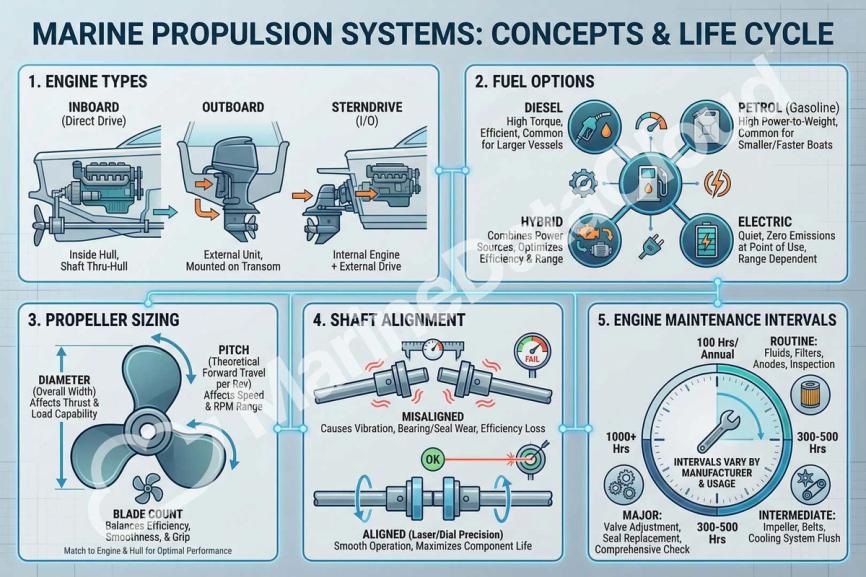
Inboard engines are mounted within the hull, with the drive shaft passing through the bottom of the boat to a fixed propeller. This arrangement offers excellent weight distribution, improved handling in heavy seas, and quieter operation at cruising speeds. Inboards are the standard choice for larger vessels, displacement cruisers, and performance sports boats where interior space and stability matter. The trade-off is accessibility — servicing an inboard engine demands patience and, occasionally, a contortionist's flexibility.
Outboard engines clamp or bolt to the transom and combine engine, gearbox, and propeller into a single self-contained unit. Their defining advantage is simplicity: tilt them clear of the water, and antifouling the hull becomes straightforward. Outboards are easily removable for workshop servicing, and modern four-stroke outboards from Yamaha, Mercury, and Suzuki have transformed reliability expectations in this category. They dominate the small-to-medium powerboat segment and are increasingly found on vessels up to 40 feet thanks to high-output multi-engine configurations.
Sterndrive engines — also known as inboard/outboard (I/O) systems — marry an inboard engine block to an outboard-style lower unit that pivots for steering and can be tilted clear of the water. This hybrid configuration delivers excellent manoeuvrability, clean hull lines, and good performance across a broad range of hull types. Sterndrive systems, most notably from Volvo Penta and MerCruiser, are particularly popular in sports cruisers and family day boats. The catch is the bellows and gimbal ring assembly: these rubber seals are a known wear point and require diligent inspection every season.
Diesel, Petrol, or Electric: The Fuel Debate
The choice of fuel type is as much a lifestyle decision as a technical one.
Diesel remains the undisputed workhorse of serious blue-water cruising and commercial operations. Diesel fuel carries more energy per litre than petrol, burns at lower temperatures, and produces a far less explosive vapour — a critical safety advantage at sea. Marine diesels from manufacturers such as Yanmar, Volvo Penta, and Cummins are engineered for continuous-duty use, routinely achieving 5,000 to 10,000 hours between major overhauls when properly maintained. Their torque characteristics make them ideal for driving larger propellers at efficient, economical speeds.
Petrol (gasoline) engines are lighter, less expensive to purchase, and deliver higher power-to-weight ratios at lower cost — factors that favour smaller, faster vessels. The principal concerns are fuel vapour accumulation in enclosed bilge spaces and higher running costs over time. For a runabout, a ski boat, or a small centre console, petrol outboards remain entirely practical. For anything venturing offshore, diesel's safety profile is difficult to argue against.
Electric propulsion is the fastest-growing segment in recreational boating, and with good reason. Electric motors are mechanically simpler than combustion engines, produce zero direct emissions, operate almost silently, and deliver instant, linear torque across the entire RPM range. Brands such as Torqeedo, ePropulsion, and Oceanvolt are now offering credible solutions for everything from tenders to 50-foot sailing yachts. Range anxiety remains the principal constraint, with battery energy density still lagging behind liquid fuels — but the technology curve is steep and the trajectory is unmistakably upward.
The Rise of Hybrid Marine Powertrains
The most significant propulsion story of this decade is the emergence of hybrid marine powertrains — systems that combine a conventional combustion engine with an electric motor and a battery bank, enabling the vessel to switch between drive modes depending on conditions, range, and environmental requirements.
The global marine hybrid propulsion market was valued at approximately USD 2.96 billion in 2024 and is projected to reach USD 6.78 billion by 2032 — a compound annual growth rate that tells its own story about the direction of travel. Hybrid systems deliver measurable fuel savings at low speeds, enable silent electric-only motoring in sensitive anchorages or restricted waterways, and recover energy through regenerative charging under sail — a particular advantage for long-distance cruisers.
For boat buyers evaluating new builds, hybrid drivetrain options from Volvo Penta, ZF, and Fischer Panda are increasingly mainstream. For existing vessel owners, bolt-on electric shaft drive conversions are becoming a realistic upgrade pathway.
Propeller Sizing: The Science of Getting It Right
Your propeller is the final point of energy transfer between your engine and the water. Get the sizing wrong, and even the finest engine in the world will under-perform, over-rev, or damage itself.
Propeller selection is governed by two primary dimensions: diameter and pitch. Diameter is determined principally by hull type — the propeller must fit within the tip clearance constraints of the hull, with a minimum of 10% of the propeller diameter as clearance from the hull for V-bottom vessels, and 15% for round-bilge hulls. Pitch describes the theoretical advance of the propeller per revolution, expressed in inches. A higher pitch moves more water per revolution but demands more engine torque to turn; too much pitch and you will be unable to reach the engine's design RPM at wide-open throttle, leading to chronic lugging and premature engine wear.
The number of blades affects the balance between thrust, efficiency, and vibration. Three-blade propellers remain the most common configuration for general use, offering a good efficiency/vibration compromise. Four- and five-blade designs reduce vibration and improve holding power in reverse at the cost of marginal top-end speed — an acceptable trade-off for many cruising sailors.
When in doubt, consult your engine manufacturer's propeller selection guide and match the propeller specification to the rated WOT (wide-open throttle) RPM range for your engine.
Shaft Alignment: The Silent Killer of Transmissions
Of all the mechanical issues that bedevil boat owners, misaligned propeller shafts are among the most insidious. Shaft misalignment — even by fractions of a millimetre — places chronic stress on the shaft seal (cutless bearing), the stuffing box or mechanical seal, the transmission coupling, and ultimately the gearbox itself.
Symptoms of misalignment include persistent vibration underway, unusual noise from the stern tube, rapid wear on cutless bearings, and transmission oil leaks. A professional shaft alignment check should be carried out whenever an engine is re-bedded, after any hard grounding, and as part of every comprehensive haulout inspection. The process involves checking the alignment of the engine mounts, coupling faces, and shaft using feeler gauges and dial indicators — straightforward work for a qualified marine engineer, but not something to defer indefinitely.
Engine Maintenance Intervals: The Rhythm of Reliability
Marine engines operate in a uniquely demanding environment — salt air, high humidity, vibration, and load profiles that would horrify an automotive engineer. Adhering to manufacturer-specified service intervals is not optional; it is the foundation of everything.
A typical annual service schedule for a marine diesel engine includes:
- Engine oil and filter change — typically every 100–150 hours or annually, whichever comes first
- Fuel filter replacement — both primary (water-separating) and secondary filters
- Impeller inspection/replacement — the raw-water pump impeller is a consumable; replace it every one to two seasons
- Belt and hose inspection — check all drive belts and coolant hoses for cracking or wear
- Zinc anode replacement — sacrificial zincs protect the engine's heat exchanger from galvanic corrosion
- Valve clearance checks — typically every 500 hours on naturally aspirated diesels
- Gearbox oil change — often overlooked, always consequential
For petrol engines, the addition of spark plug inspection and ignition system checks rounds out the schedule. Electric motors, by contrast, require minimal scheduled maintenance beyond checking terminal connections, inspecting cooling systems, and monitoring battery management system health.
Reading the Hour Meter: What Those Numbers Really Tell You
Every seasoned marine surveyor will tell you the same thing: the hour meter is the beginning of the conversation, not the end of it.
Engine hours on a boat are analogous to mileage on a vehicle, but the analogy is imperfect. A diesel engine run consistently at displacement cruising speeds — perhaps 70% of load — will last far longer than the same engine abused with short runs, infrequent servicing, and long periods of inactivity. Context is everything.
As a general guide:
- 0–500 hours — Low hours; assess service history and storage conditions carefully. Inactivity causes more corrosion damage than use.
- 500–1,500 hours — Moderate hours for a well-maintained diesel; expect wear items to have been serviced, but no major concerns.
- 1,500–3,000 hours — Higher hours; a full service history is essential. Inspect injectors, heat exchangers, and turbocharger condition on a diesel.
- 3,000+ hours — Not necessarily alarming. Many commercial marine diesels run well beyond 10,000 hours with regular maintenance. Ask for comprehensive documented service records.
What the hour meter cannot tell you: how hard those hours were run, whether the cooling system was properly flushed after salt water use, whether the engine sat unused for years, or whether impeller failures led to overheating events. Cross-reference the hour reading with the service logbook, inspect the engine physically for oil leaks, corrosion, and exhaust staining, and commission a professional pre-purchase survey for any significant acquisition.
A low hour meter on a poorly maintained engine is a warning, not a reassurance. A high hour meter on a meticulously serviced engine is a testament to good ownership.
Summary: Key Takeaways for the Confident Boat Owner
- Propulsion configuration matters — choose inboard, outboard, or sterndrive based on vessel type, use case, and maintenance preference, not convention alone.
- Diesel dominates offshore — for range, safety, and longevity, diesel remains the gold standard for serious cruising.
- Electric and hybrid are the future — zero-emission propulsion is no longer a fringe technology; it is a mainstream and growing market segment.
- Propeller sizing is precision engineering — matching diameter, pitch, and blade count to your engine and hull is fundamental to performance and engine health.
- Shaft alignment is not optional — misalignment silently destroys transmissions and stern gear; inspect it every haulout.
- Service intervals are your engine's lifeline — follow them rigorously, document everything, and keep the logbook up to date.
- Hour meters tell a story, not the whole truth — always cross-reference hours with service history, physical condition, and professional survey findings.
The engine room is where confident boat ownership is earned. Know your system, respect its demands, and it will carry you safely over every horizon ahead.