The Maintenance Log: Why Meticulous Record-Keeping Is a Seamanship Skill
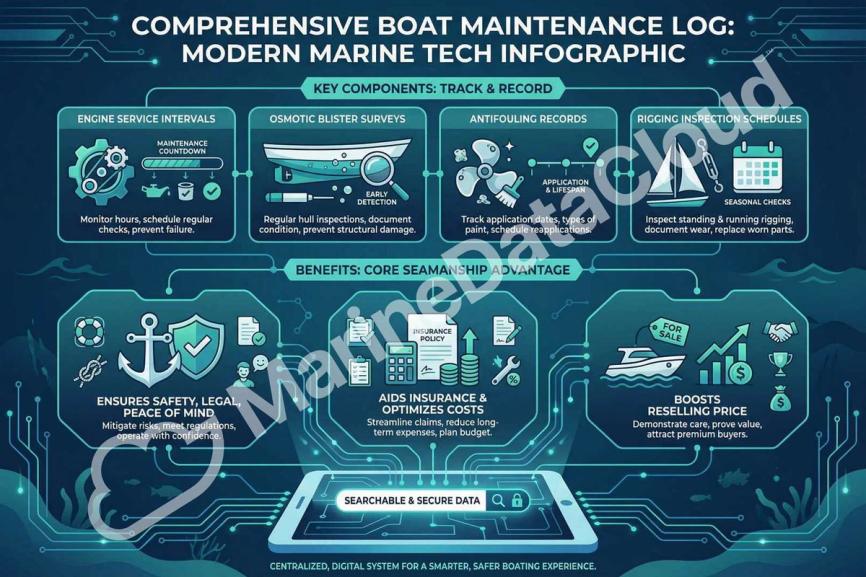
From Hardware to Data: The Logbook as a Living Document
There is a moment in every skipper's life when the penny drops. It is not when the engine coughs on a flat calm a mile offshore, nor when the rigger points to a swaged terminal that looks — merely looks — questionable. It is the moment you realise you cannot actually prove when it was last inspected. No date. No name. No record. Just a vague, sinking feeling that somewhere between your last two boats, the most important piece of safety equipment you ever owned was not a flare pack, a life raft, or an EPIRB. It was a logbook.
Seamanship has always been, at its core, an act of disciplined observation and recorded knowledge. The great maritime republics understood this instinctively. Venice, at the height of her naval and commercial power in the 13th and 14th centuries, ran the Arsenale — the world's first industrial shipyard — on a foundation of meticulous administrative record-keeping. Every galley constructed, every timber consigned, every caulking contract signed was logged. The scribes of the Venetian Senate tracked cargo manifests, crew rosters, and vessel conditions across trade routes stretching from the Adriatic to the Black Sea. Genoa's merchant families maintained cartulari — notarial registers that recorded not only financial transactions but the seaworthiness declarations of vessels departing their harbour. These were not bureaucratic niceties. They were the instruments of accountability upon which entire trading empires were built.
The modern skipper commands a vessel infinitely more complex than a 14th-century merchant galley — and yet the principle remains unchanged. A boat is a system of interacting systems, and every one of them has a service life, an inspection interval, and a failure mode. Without a centralised, comprehensive maintenance record, you are not managing your vessel. You are guessing.
The Engine Room: Where Intervals Are Non-Negotiable
Let us begin with the beating heart of most modern cruising and motor vessels: the marine diesel engine. Whether you are running a Yanmar 4JH, a Volvo Penta D4, or a Perkins M92B, the manufacturer's service schedule is not a suggestion — it is the operational baseline below which degradation accelerates and warranties dissolve.
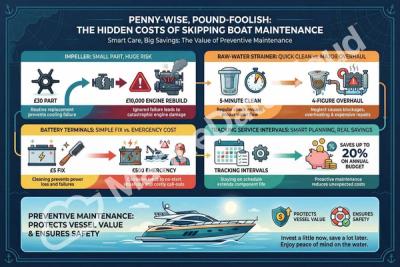
Standard inboard diesel service intervals typically include engine oil and filter changes every 100–150 hours or annually (whichever comes first), impeller replacement every season or 200–300 hours, fuel filter servicing every 200–250 hours, coolant system checks, heat exchanger inspections, and belt and hose condition assessments. Each of these tasks has a precise date, a mileage-equivalent in engine hours, and ideally the name of the engineer or yard who performed it.
The engine log is not simply a maintenance diary — it is a diagnostic tool. Patterns of oil consumption, coolant top-ups, or recurring alarm activations recorded over time will often reveal an incipient problem weeks or months before it becomes a catastrophic failure at sea. An engine that has consumed 50ml of coolant over three years tells a completely different story to one that has consumed 50ml in three months. Without longitudinal records, you cannot read that story at all.
From an insurance standpoint, a vessel that suffers a major mechanical failure — a seized engine, a catastrophic overheating event — may face a contested claim if the owner cannot demonstrate that routine servicing was carried out in accordance with the manufacturer's schedule. Insurers are not unreasonable; they simply require evidence. The maintenance log is that evidence.
The Hull Below the Waterline: Osmotic Blister Surveys and Bottom Paint Records
Below the waterline lies one of the most expensive threats in fibreglass boat ownership: osmotic blistering, commonly referred to as osmosis. Caused by the ingress of water through the gelcoat and into the laminate, where it reacts with unreacted resins and forms acidic solutions, osmotic blistering is a slow, progressive, and entirely manageable condition — provided it is caught early and tracked carefully.
A responsible blister survey involves documenting the number, distribution, size, and depth of any blisters found during each haulout, along with moisture meter readings taken across the hull using a Sovereign Tramex or similar instrument. Comparing these readings year on year against a recorded baseline is the only reliable way to determine whether a hull's condition is stable, improving after a previous epoxy barrier coat treatment, or deteriorating.
Antifouling records are equally critical. Knowing which product was applied — hard matrix, self-polishing copolymer, or tin-free ablative — its batch number, application thickness in microns (or number of coats), and date of application is essential for two reasons. First, certain antifouling formulations are chemically incompatible and should not be applied over one another without an appropriate tie-coat. Second, and perhaps more importantly for performance sailors and cruisers alike, understanding how long a given product lasted under your specific conditions — mooring location, season length, haul-out frequency — allows you to optimise your bottom paint strategy year on year rather than starting from scratch each season.
Most antifouling coatings require reapplication every 12 to 24 months. Hard antifouling in high-fouling waters may require underwater cleaning every 45 to 60 days during peak season. Without records, you are applying paint to a hull with an unknown history — and that is precisely the situation that leads to delamination, poor performance, and unnecessary expenditure.
Aloft and Under Tension: Rigging Inspection Schedules
If the engine room is the heart of the vessel, the rig is its spine — and spines do not fail gracefully. A dismasting offshore is not a minor inconvenience; it is a potentially life-threatening emergency that can hole the hull, injure crew, and render a vessel incapable of self-rescue.
Standing rigging inspection is one area where the absence of records carries the starkest consequences. Stainless steel wire rigging is generally considered serviceable for up to 10 years under normal conditions, with most insurers and experienced riggers recommending full replacement at that interval regardless of apparent condition. The reasoning is straightforward: stainless steel can suffer from crevice corrosion and inter-granular stress corrosion cracking that is entirely invisible to the naked eye, particularly within swaged terminals and behind toggle fittings.
A rigorous rigging log should record the date and type of every annual visual inspection, any dye-penetrant or magnetic particle testing carried out on terminals, the condition and lubrication status of toggles, turnbuckles, clevis pins, and cotter pins, the age and provenance of the wire or rod, and the service history of the mast itself — including any unplanned loadings from gybes, knockdowns, or contact events.
Running rigging — halyards, sheets, control lines — should also be logged, noting replacement dates, any evidence of core damage or UV degradation, and the condition of sheaves and blocks. Synthetic rigging materials such as Dyneema and PBO require their own specific inspection protocols, particularly with regard to UV exposure and chemical contamination, with replacement typically recommended every five to ten years depending on use.
It is worth noting that several marine insurers now explicitly require evidence of rigging inspection as a condition of offshore passage cover. Without a dated inspection record from a qualified rigger, you may find yourself technically uninsured mid-ocean — a discovery best made before casting off the dock lines.
The Paper Trail That Pays: Insurance and Resale Documentation
Beyond the purely operational arguments, the maintenance log carries substantial financial weight. Two vessels of identical make, model, and year can command dramatically different prices at resale — and the differentiating factor is almost invariably the quality and completeness of their service documentation.
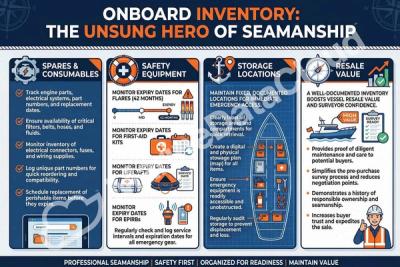
A buyer's surveyor will ask for engine hours and service records as a matter of routine. They will want to see haulout reports, blister survey data, antifouling history, and rigging replacement dates. They will scrutinise warranty documentation, equipment receipts, and any records of structural work or osmosis treatment. A vessel with a complete, well-organised, chronological service history commands buyer confidence — and buyer confidence translates directly into a higher asking price and a faster sale.
From an insurance perspective, the logic is equally compelling. In the event of a claim — fire, collision, sinking, theft of equipment — a comprehensive inventory and maintenance record provides the insurer with the documentary basis to settle the claim promptly and fairly. Without it, every item of disputed value becomes a negotiation, and the burden of proof falls entirely on the policyholder.
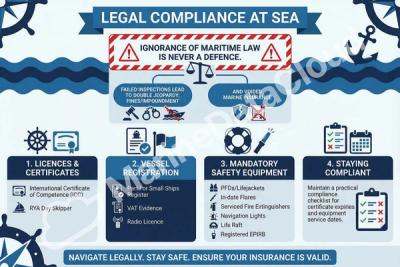
There is also a growing body of case law and insurance arbitration precedent suggesting that owners who cannot demonstrate a pattern of reasonable maintenance may find their claims reduced or denied on the grounds of contributory negligence. The maintenance log is not merely a convenience — in certain circumstances, it is a legal shield.
The Digital Quarterdeck: Centralised, Searchable, Secure
The Venetian Senate's scribes kept their records in secure cancellarie — purpose-built archive rooms with restricted access and fire-resistant stone construction. The principle behind that institutional architecture — centralisation, security, accessibility — is precisely what the modern skipper requires in a digital maintenance management system.
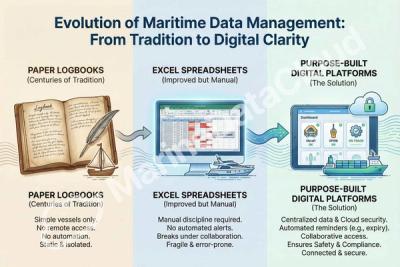
A paper logbook stored in a chart table drawer is infinitely better than no logbook at all. But it shares a single, unrecoverable copy with bilge water, galley fires, and the general entropy of marine environments. A spreadsheet on a laptop is more durable — until the hard drive fails, the file becomes corrupted, or the laptop goes over the side.
The contemporary solution is a centralised, cloud-backed, vessel management platform: a digital quarterdeck where every service record, survey report, receipt, certificate, and inspection log is stored, searchable, and accessible from any device, anywhere in the world. Imagine being able to pull up the exact date of your last impeller change whilst talking to a mechanic in a foreign port, or to share your full rigging history with an insurer via a secure link whilst sitting in a marina bar. Imagine never again having to answer the question "when was this last serviced?" with anything other than a precise, dated, documented fact.
This is not a luxury feature for superyacht managers. It is a core seamanship tool for any skipper who takes their vessel — and their responsibilities to their crew — seriously.
Summary: What Every Skipper Should Take Away
The maintenance log is not paperwork. It is seamanship. Here are the key principles every vessel owner should take aboard:
- Engine service records are both a safety instrument and an insurance requirement. Log every oil change, filter replacement, impeller swap, and hour of use — dated, with the performing engineer noted.
- Osmotic blister surveys should be conducted at every haulout, with moisture meter readings recorded against a baseline to track hull condition over time — not just at the moment of survey.
- Antifouling records must include product name, formulation type, date of application, number of coats, and prevailing conditions, enabling year-on-year optimisation and preventing costly compatibility errors.
- Rigging inspection schedules should follow a minimum annual visual inspection regime, with full rig pulls every five to six years and standing wire replacement at the 10-year mark — all documented with dated records from qualified riggers.
- Insurance documentation — equipment inventories, survey reports, certificates, and service histories — must be comprehensive, organised, and instantly accessible to support claims and satisfy underwriter requirements.
- Centralisation and digital storage transform a collection of scattered paperwork into a searchable, shareable, and secure operational asset that protects both the vessel and the skipper's financial interests.
The great maritime republics built their dominance on the discipline of recorded knowledge. The skipper who embraces the same discipline — with the same rigour, and the right modern tools — is better equipped, better protected, and better prepared for whatever lies over the next horizon.